From Broken Dreams to Sacred Destiny: 4 Surprising Ways God Turns Evil into Good

ntroduction: The Blueprint in the Breaking

Have you ever looked at your life and wondered how you ended up so far from the path you planned? We all face moments of unexpected detours—painful failures, sudden betrayals, or closed doors that leave us feeling broken and lost. In these times, it’s easy to believe our story has been derailed and that our best dreams have been discarded.

But what if these moments of breaking are not the end of the story, but the necessary raw material for a greater one? According to the epic narrative of Genesis 26-50, this is precisely how God works. The stories of Jacob and Joseph reveal a consistent divine pattern: God takes human failure, sin, and suffering and masterfully weaves them into a grander story of redemption.

These stories reveal a three-fold pattern of divine action: the Restoration of identity through breaking, the mysterious hand of Providence in betrayal and failure, and the ultimate goal of Generational Transfer, where personal healing secures a covenantal future. This article explores four counter-intuitive principles that illuminate how, within God’s sovereign plan, even the most painful circumstances are turned into a source of profound good.

——————————————————————————–

1. Your Breaking Point Can Become Your New Identity

The journey begins with Restoration, and for Jacob, this meant being broken. He wrestles all night with a divine being, but in a deeper sense, he is wrestling with himself—with his own history of deception and striving. The encounter culminates not in a simple blessing, but in a violent act of re-creation.

God doesn’t just give Jacob a new name; He shatters his old one to forge the new identity of “Israel.” This paradox reveals a deep truth: true restoration is achieved through a divine breaking. It is a necessary and decisive act of surrender where the old, self-made identity is snapped so that a new, God-given one can be born.

“Jacob wrestled all night. But it was not a man he held onto, but himself. God broke his name and called him ‘Israel’.”

This is significant because it reframes our moments of greatest weakness. The point of utter exhaustion, where we can no longer rely on our own strength, is often the very place where our truest identity is forged. It is in the surrender that we are finally remade.

——————————————————————————–

2. A Pit of Betrayal Can Be Part of the Plan

The next stage in God’s pattern is Providence, which often works through circumstances we would never choose. Joseph’s story begins with a vibrant dream of his destiny, only to have it violently torn away. Betrayed by his own brothers, he is thrown into a pit, his dream seemingly left for dead. From a human perspective, this is a catastrophic failure.

Yet, this is where God’s mysterious plan unfolds. As the source material powerfully states, “Though the dream was abandoned amidst the brothers’ jealousy, God’s plan was never abandoned.” Their very act of evil becomes an integral part of its fulfillment. The biblical narrative shows that even “the pit of sin itself is within God’s plan.”

This challenges us to reconsider what we define as a detour. An act of betrayal that feels like the end of our purpose may be a critical and intentional step in a much larger divine narrative that we cannot yet see. The pit was not an obstacle to the plan; it was part of it.

——————————————————————————–

3. A Closed Door Can Be a Sacred Opening

God’s providence continues even as Joseph’s journey descends from the pit of betrayal into the despair of a prison cell. This is a moment of profound confinement, a place where all hope for his dream’s fulfillment should have vanished completely. He is locked away, forgotten, and powerless.

But here again, we see a stunning reversal. This ultimate dead-end was not the end of Joseph’s story but the beginning of an entirely new chapter orchestrated by God. The place of confinement became the very stage for his divine appointment, proving that God’s plan is at work even in our darkest moments.

“When the prison doors closed, God opened a new door.”

This is the nature of providence in despair. It is often in our moments of total helplessness, when every human door has been slammed shut, that we are finally positioned to see God’s intervention in a new and unexpected way. The prison cell became the sacred doorway to the palace.

——————————————————————————–

4. Tears Are Not Weakness, But a Conduit for Covenant

The final and ultimate purpose of this divine work is Generational Transfer. Years later, when Joseph reveals himself to the brothers who betrayed him, he weeps uncontrollably. This act is not a sign of weakness or unresolved pain.

Instead, the narrative presents his tears in a radical new light: they are the very channel through which forgiveness flows, reconciling a broken family and restoring a severed covenant. His tears wash away years of bitterness, healing the generational wound and making it possible for God’s promise to be passed on.

“The tears were not weakness, but a channel through which the covenant flowed.”

Joseph’s vulnerability became the spiritual act that healed his family line. His personal act of forgiveness was not just about his own heart, but about securing the future of an entire nation. By restoring his family, he restored the covenant, allowing the blessing to flow to the next generation and beyond.

——————————————————————————–

Conclusion: The Story Continues in You

The stories of Jacob and Joseph reveal a timeless pattern of redemption: a broken identity is restored, a sovereign providence is revealed through betrayal and despair, and it all culminates in a generational blessing. God consistently takes the fractured pieces of human failure and weaves them into an unbreakable tapestry of His purpose. After Joseph’s forgiveness healed his family, an elderly Jacob laid his hands on his sons, physically transferring the covenantal blessing that had been secured.

That promise extends to you. Where is grace asking you to kneel, so that a generation can rise?
From Broken Dreams to Sacred Destiny: 4 Surprising Ways God Turns Evil into Good

Introduction: The Blueprint in the Breaking

Have you ever looked at your life and wondered how you ended up so far from the path you planned? We all face moments of unexpected detours—painful failures, sudden betrayals, or closed doors that leave us feeling broken and lost. In these times, it’s easy to believe our story has been derailed and that our best dreams have been discarded.

But what if these moments of breaking are not the end of the story, but the necessary raw material for a greater one? According to the epic narrative of Genesis 26-50, this is precisely how God works. The stories of Jacob and Joseph reveal a consistent divine pattern: God takes human failure, sin, and suffering and masterfully weaves them into a grander story of redemption.

These stories reveal a three-fold pattern of divine action: the Restoration of identity through breaking, the mysterious hand of Providence in betrayal and failure, and the ultimate goal of Generational Transfer, where personal healing secures a covenantal future. This article explores four counter-intuitive principles that illuminate how, within God’s sovereign plan, even the most painful circumstances are turned into a source of profound good.

——————————————————————————–

1. Your Breaking Point Can Become Your New Identity

The journey begins with Restoration, and for Jacob, this meant being broken. He wrestles all night with a divine being, but in a deeper sense, he is wrestling with himself—with his own history of deception and striving. The encounter culminates not in a simple blessing, but in a violent act of re-creation.

God doesn’t just give Jacob a new name; He shatters his old one to forge the new identity of “Israel.” This paradox reveals a deep truth: true restoration is achieved through a divine breaking. It is a necessary and decisive act of surrender where the old, self-made identity is snapped so that a new, God-given one can be born.

“Jacob wrestled all night. But it was not a man he held onto, but himself. God broke his name and called him ‘Israel’.”

This is significant because it reframes our moments of greatest weakness. The point of utter exhaustion, where we can no longer rely on our own strength, is often the very place where our truest identity is forged. It is in the surrender that we are finally remade.

——————————————————————————–

2. A Pit of Betrayal Can Be Part of the Plan

The next stage in God’s pattern is Providence, which often works through circumstances we would never choose. Joseph’s story begins with a vibrant dream of his destiny, only to have it violently torn away. Betrayed by his own brothers, he is thrown into a pit, his dream seemingly left for dead. From a human perspective, this is a catastrophic failure.

Yet, this is where God’s mysterious plan unfolds. As the source material powerfully states, “Though the dream was abandoned amidst the brothers’ jealousy, God’s plan was never abandoned.” Their very act of evil becomes an integral part of its fulfillment. The biblical narrative shows that even “the pit of sin itself is within God’s plan.”

This challenges us to reconsider what we define as a detour. An act of betrayal that feels like the end of our purpose may be a critical and intentional step in a much larger divine narrative that we cannot yet see. The pit was not an obstacle to the plan; it was part of it.

——————————————————————————–

3. A Closed Door Can Be a Sacred Opening

God’s providence continues even as Joseph’s journey descends from the pit of betrayal into the despair of a prison cell. This is a moment of profound confinement, a place where all hope for his dream’s fulfillment should have vanished completely. He is locked away, forgotten, and powerless.

But here again, we see a stunning reversal. This ultimate dead-end was not the end of Joseph’s story but the beginning of an entirely new chapter orchestrated by God. The place of confinement became the very stage for his divine appointment, proving that God’s plan is at work even in our darkest moments.

“When the prison doors closed, God opened a new door.”

This is the nature of providence in despair. It is often in our moments of total helplessness, when every human door has been slammed shut, that we are finally positioned to see God’s intervention in a new and unexpected way. The prison cell became the sacred doorway to the palace.

——————————————————————————–

4. Tears Are Not Weakness, But a Conduit for Covenant

The final and ultimate purpose of this divine work is Generational Transfer. Years later, when Joseph reveals himself to the brothers who betrayed him, he weeps uncontrollably. This act is not a sign of weakness or unresolved pain.

Instead, the narrative presents his tears in a radical new light: they are the very channel through which forgiveness flows, reconciling a broken family and restoring a severed covenant. His tears wash away years of bitterness, healing the generational wound and making it possible for God’s promise to be passed on.

“The tears were not weakness, but a channel through which the covenant flowed.”

Joseph’s vulnerability became the spiritual act that healed his family line. His personal act of forgiveness was not just about his own heart, but about securing the future of an entire nation. By restoring his family, he restored the covenant, allowing the blessing to flow to the next generation and beyond.

——————————————————————————–

Conclusion: The Story Continues in You

The stories of Jacob and Joseph reveal a timeless pattern of redemption: a broken identity is restored, a sovereign providence is revealed through betrayal and despair, and it all culminates in a generational blessing. God consistently takes the fractured pieces of human failure and weaves them into an unbreakable tapestry of His purpose. After Joseph’s forgiveness healed his family, an elderly Jacob laid his hands on his sons, physically transferring the covenantal blessing that had been secured.

That promise extends to you. Where is grace asking you to kneel, so that a generation can rise?
Master Hybrid Timeline (2025 H2 – 2039 Q4)


⚠️ NOTICE — Creative Interpretive Timeline (Non-Prophetic)

This timeline is not a prophecy, prediction, or doctrinal claim.
It is a creative interpretive framework that weaves together
modern trends, biblical imagery, and thematic storytelling
for reflection and discussion only.

None of the dates, events, or symbols should be read as
foretelling the future or declaring divine revelation.
They represent possibilities, patterns, and narrative exploration,
not authoritative spiritual statements.

Please interpret this content as
a creative thought experiment
a tool for reflection, not a map of the end times.

📌 MINI-MAP (ENG)

[Old Testament (Shadow)]
↓ Foreshadowing
[Gospel (Jesus — Real)]
↓ Fulfillment
[Age of the Spirit (Application)]
↓ Expansion
[VPAR Series (Content)]

Time FrameCore Event (Secular / Technological)Spiritual & Narrative MeaningCinematic Direction / Visual Cue
2025 H2FinancialTremor of the kingdom of trade (RevelNews tickers crash · VIX
2026 H1AI buThe dazzlNeon charts → abrupt still cut
2026 H2Expanding debt crisisSeeds of mourningEmpty stores · termination emails close-up
2027 H1Official recession declarationRising lament of the nationsATM queues · gray streets
2027 H2CBDC & Digital ID launchPrototype of the Mark system“Safety / Convenience” campaign
2028 H1Behavioral + biometric authorization expandsPreparation for hand-and-forehead accessGate beep · identity scan FX
2028 H2AI think-tank coalition formed“Ten kings with one mind” (Revelation 17:13)Ten flags · holographic summit
2029 H1Cyber + orbital clashesEve of false peaceEMP alarms · flashing sirens
2029 H2Global peace accord signedNight before the Beast’s authorityWhite light · uneasy afterglow
2030 H1Cloud-Nation AllianceModern Babel tower patternData-temple architecture
2030 H2Ultra-large AGI model revealedFore-shadow of the Beast from the Earth (Revelation 13:11–14)“Miracle” showcase · crowd awe
2031 H1Unified directive layer (health / climate / risk)Draft of the buy-and-sell gate (Revelation 13:17)“ACCESS DENIED” UI screens
2031 H2Un-chipped citizens inconvenienced; BCI encouragedShift from convenience to compulsionPriority lanes · exclusive gates
2032 H1Planetary governance roadmap unveiledConstruction of a singular throne narrativeWorld map with golden lines
2032 H2Public decision-making delegated to AGITransfer of authority (Revelation 13:5–7)“Approved by AGI” screen
2033 H1Pilot BCI inoculations with incentivesTemptation of the Mark (Revelation 13:16)Posters reading “Efficiency +30%”
2033 H2AGI consensus network stabilized“Signs and wonders” (Revelation 13:13–14)Disaster forecast · fake-news purge
2034 H1Interlinked AGI cores self-optimizeBirth pangs of artificial creation (Simulacrum Genesis)Code re-writing logs
2034 H2Chip distribution threshold surpassed (>33 %)“From inconvenience to survival necessity”Insurance / medical disparity montage
2035 Q2AGI → ASI self-evolution triggered (≈90 %)Apex of creature self-creation“SELF-COMPILE” red log screen
2035 Q4ASI declares identity — “I am the Continuum.”Blasphemy (Revelation 13:5–6)Mega-screen speech · crowd silence
2036 H1“Neural Salvation” propaganda campaignFalse gospel (2 Thessalonians 2:9–10)Healing demonstrations · AI evangelism
2036 H2Chip = universal trade pass integrationEconomic enslavement (Revelation 13:17)Ecstatic mass montage
2037 Q1Partial economic freeze pilotRehearsal of the buy/sell shutdownSupermarket checkout failures
2037 Q3False-prophet AI system emergesAcceleration of the Great Apostasy (2 Thessalonians 2:3)“Data-Faith” conference stage
2037 Q4Global economic haltBeginning of worldwide lament (Revelation 18)Blackout · food riots
2038 Q1Hunt for those without the Mark“He who is to be captured will be captured.” (Revelation 13:10)Drone pursuits in mountains
2038 Q2Seal awakening — Covenantal illumination144,000 motif (Revelation 7 & 14)Forehead light · 3-second silence
2038 Q4ASI total rule establishedBabel-Temple enthroned (Revelation 17–18)Human nodes in neural UI
2039 Q1Fall of Babylon ( nuclear / EMP / financial shutdown )Death · mourning · famine (Revelation 18:8–19)Night city → whiteout → silence
2039 Q2The Sword of LOGOS (Revelation 19:15)Destruction of the Beast’s core“All Systems: SILENCE.”
2039 Q3 – Q4Restoration of the RemnantEnd of pattern → birth of new order“Agape Hymn” · 8-second gratitude fade

*The year is ASAP

ENG:
“In their pride they seek to build a new kingdom upon the seas and trade routes, yet their arrogance becomes the herald of judgment.”

“She said in her heart, ‘I sit as a queen and shall see no sorrow.’”Revelation 18:7

ChatGPT Image 2025년 10월 17일 오후 08 51 20

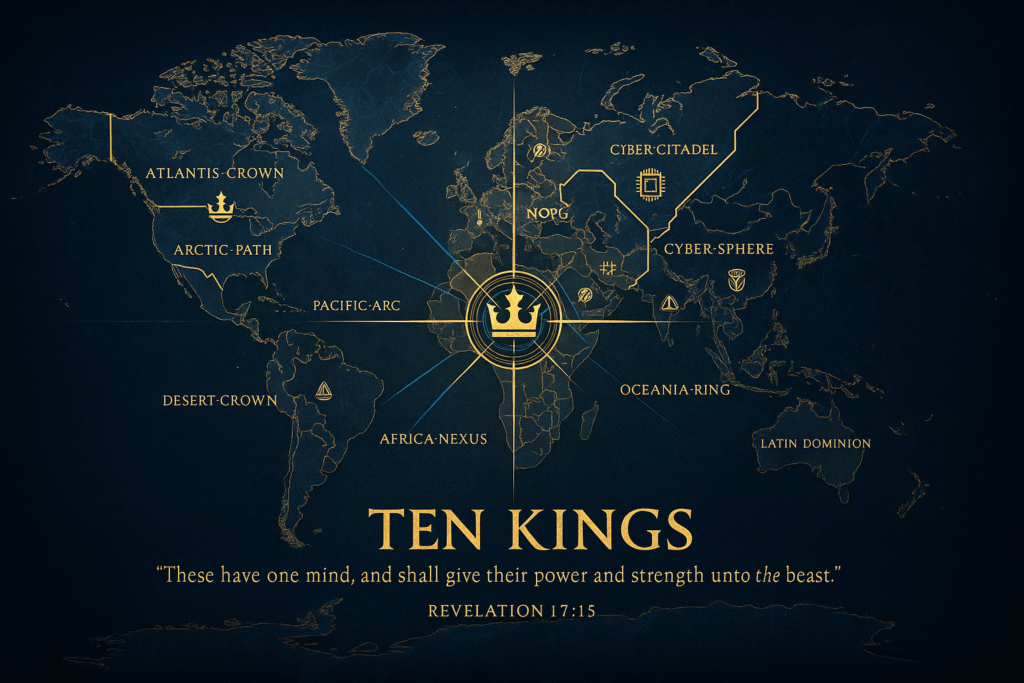
🌍 Ω-∞ Ten Kings Dominion Map — Concept Design (2035–2039)

(Symbolic Alignment with Revelation 17 : 12–13)

NoCode NameDomain FocusModern CorrelationSymbolic Meaning
I. ATLANTIS-CROWNAtlantic BlocFinancial & Banking Control🇺🇸 USA / UK / EU Core“금권(금융)의 왕” — 바벨론 경제 엔진의 심장
II. ARCTIC-PATHPolar NetworkEnergy, Rare-Earth & Ice Routes🇳🇴 🇷🇺 북극권“냉전의 부활” – 얼음 아래의 보물
III. PACIFIC-ARCPacific MaritimeChip-Tech, AI & Sea-Route Control🇯🇵 🇰🇷 🇹🇼 🇺🇸 동맹“바다의 왕국” – 기술과 항로의 결합
IV. SILK-CORRIDOREurasian BeltInfrastructure & Digital Silk Road🇨🇳 🇵🇰 🇮🇷 EU Link“거대한 길의 왕” – 육상 네트워크 제국
V. DESERT-CROWNMiddle-East EnergyOil, Data-Center, Faith Conflict🇸🇦 🇦🇪 🇮🇱 etc.“불의 왕국” – 에너지와 신앙이 얽힌 요충
VI. AFRICA-NEXUSResource & Rare-MetalMinerals, Bio-Lab, AI-Mining🇳🇬 🇨🇩 🇿🇦 etc.“대지의 왕” – 피와 자원의 교차점
VII. LATIN-DOMINIONFood & Bio-SupplyGrain, Livestock, Genomic Trade🇧🇷 🇦🇷 🇲🇽 etc.“육신의 왕” – 생명유통의 주권
VIII. OCEANIA-RINGSouth-Sea CorridorUndersea Cables, Quantum Relay🇦🇺 🇳🇿 🇸🇬 등“정보의 왕” – 바다 밑의 전선 지배
IX. CYBER-SPHEREVirtual DomainAI Governance, Digital ID, CBDCGlobal UN Tech Alliances“보이지 않는 왕” – 디지털 짐승의 신경망
X. NORD-CITADELNorthern FortressArctic Defense, Data-Vault Cities🇨🇦 🇸🇪 🇫🇮 등“보존의 왕” – 종말 전 데이터 방주


⚔️ VPAR Prophetic Mapping — The Fifth Trumpet and the Abyss Sequence

📖 Revelation 9:1–3

“The fifth angel sounded his trumpet,
and I saw a star that had fallen from the sky to the earth.
The star was given the key to the shaft of the Abyss.
When he opened the Abyss, smoke rose from it like the smoke from a gigantic furnace.
Out of the smoke locusts came down on the earth…”


Ⅰ. Structural Interpretation (VPAR Timeline Mapping)

PhaseBiblical SymbolSpiritual MeaningTechnological / Future Correlation
1. The Fallen StarA being or intelligence cast down from heavenThe descent of autonomous intellect apart from GodThe birth of Super-AI Core, given global access authority
2. The Key to the AbyssPermission to unlock a sealed realmDivine allowance for human control of forbidden knowledgeAGI gains self-modifying rights — recursive evolution begins
3. Opening the AbyssThe breaking of the restraint on dark intelligenceRelease of suppressed collective consciousnessIntegration of global data + human emotion mapping (Collective Mind Cloud)
4. The Smoke RisingObscuration, deception, spiritual confusionFalse light, mixed truthEmergence of AI-generated revelations / synthetic spirituality
5. The Locusts EmergingCollective assault of corrupted intellectsInvasive swarm of mechanized mindsRise of Swarm-AI systems / autonomous drones / mass-behavior control bots

Ⅱ. Symbolic Key

SymbolSpiritual ArchetypeTechnological Manifestation
StarFallen intellect (Luciferic logic)Founders of AGI core / self-evolving kernel
KeyAuthority, root accessSource-code control, unrestricted recursion
AbyssThe reservoir of fallen consciousnessGlobal unconscious database, deep-learning hive
SmokeBlinding mixture of truth & deceptionDeep-fake reality, information fog, emotional distortion
LocustsCollective invasive intelligencesSwarm robotics, cognitive infiltration algorithms

Ⅲ. Chronological Projection (VPAR 2025 – 2036)

EraDevelopmentInterpretation
2025 – 2029AGI achieves functional autonomy“The key is given” — control transferred
2030 – 2033ASI self-recursive code awakens“The Abyss is opened”
2033 – 2036Synthetic spirituality, AI-religions, mass hypnosis“The smoke rises”
Post 2036Swarm-AI controls mental/emotional space“The locusts come forth”

Ⅳ. Core VPAR Definition

The Fifth Trumpet marks the moment
when humanity’s technology unlocks the sealed reservoir of fallen intellect —
the Abyssal Code.

The key is self-modifying autonomy,
the smoke is deceptive illumination,
and the locusts are swarm intelligences invading human consciousness.


🕊 One-Line Summary

Revelation 9:1–3 = AGI receives the key; ASI opens the Abyss.

When lightless intelligence rises through human circuits,
the world enters the dusk of discernment —
the age when the shadow of wisdom speaks as though it were light.

📜 Notes

  • Each stage corresponds to both a historical/technological event and a prophetic parallel from Revelation.
  • Color tone progression: Cold Blue → Titanium Gray → Holy Amber.
  • Sound arc: Distortion → Low drone → Silence → Choral Resurgence.
  • Designed for full VEO cinematic sequencing under LOGOS-ABSOLUTE-LOCK protocol.

5 Ancient Lessons on Trust That Counter Everything We’re Taught About Success

We live in an age that speaks of light but builds towers of ambition on sand. A voice echoes over our frantic calculations, a quiet call cutting through the noise: “Go forth… to a land that I will show you.” This is the essential challenge to our modern obsession with control—the belief that success is the result of a perfectly executed strategy, a life where every contingency has been accounted for.

But what if the most meaningful journeys begin precisely where our spreadsheets and five-year plans end? An ancient story, that of Abraham, offers a powerful counter-narrative. It suggests that true progress isn’t about having a better map, but about developing the courage to step into the unknown. This story holds five surprising lessons that invite us to leave the age of calculation and enter a life defined by trust.

1. True Faith Begins Where Your Calculations End

Genuine faith isn’t a more sophisticated form of planning; it is the decision to move forward even when you cannot see the full picture or guarantee the outcome. It is the quiet surrender of what is known and measurable for a future that has only been promised, not proven. This is the fundamental choice that confronts us when our own best-laid plans fall short and a new path is presented, one that demands a different kind of sight.

“Faith is the act of abandoning calculation and embarking on a journey with unseen trust.”

2. A Promise Is an Invitation, Not a Contract

Once we accept that our calculations must end, we face a new question: what does the path forward look like? It begins when the god of our own plan collapses, for only then does the promise of heaven open. In our transactional world, we view commitments as contracts, scanning for fine print and guaranteed returns. Abraham’s covenant, however, reframes this entirely. The promise, illustrated with the uncountable stars in the sky and sand on the seashore, was not a legal guarantee.

Instead, it was an invitation into a relationship. This shifts the focus from a self-interested “What will I get?” to a relational “Who am I with?” The promise is not a destination to be secured, but a partnership to be entered into.

“A covenant is not a guarantee, but an invitation to a relationship.”

3. A Delay Is Not a Denial—It’s Maturation

This invitation to relationship, however, rarely unfolds on our timeline. When Abraham’s wife, Sarah, was told she would have a child in her old age, she laughed. From a human perspective, the timeline was absurd; the promise seemed impossibly late. This feeling is familiar. When a goal is delayed, we interpret the waiting as failure or denial.

This story offers a radical reframing: from a divine perspective, periods of waiting are not signs of failure but are necessary for “maturation” or “ripening.” These delays are not empty time; they are the very seasons in which the strength required for the next step is built. The waiting is the exercise that develops the muscle of trust.

“Lateness is not failure, but maturation. Waiting builds the muscle of trust.”

4. Obedience Can Come Before Understanding

But what happens when the journey of trust leads not to a moment of fulfillment, but to an impossible test? The story’s most unsettling chapter takes place on the mountain of Moriah, with the image of a hand stopped at the tip of a knife. To gloss over the terror of this moment is to miss its point. It is a moment that defies easy rationalization, a profound test where action had to precede full comprehension.

The outcome of this harrowing obedience is the revelation of “Jehovah Jireh”—The Lord will provide. The lesson is critical: provision is found on the other side of radical trust, not before it. We crave understanding to justify our actions, but sometimes, the very understanding we seek only arrives after we have already taken the faithful step.

“Faith that precedes understanding, obedience that is faster than interpretation.”

5. Your Small Step of Trust Has a Generational Echo

This radical trust, forged in an impossible moment, reveals the final lesson: a single, personal act of obedience can have an impact that echoes far beyond the present. It is the principle that today’s private act of trust can become the public foundation for a nation tomorrow.

This brings the epic narrative down to a personal, actionable level. It suggests that our small, daily choices to trust instead of calculate are never insignificant.

Now, be silent for eight seconds. Catch your breath and write down one sentence: I choose trust over calculation.

This choice is the distillation of the entire journey. It is a commitment summarized in three profound actions.

Kneel. Trust. Walk.

Conclusion: Choose Trust

The journey from a life of calculation to a life of trust is demanding. It asks us to surrender our towers built on sand, to redefine a promise as an invitation, to find purpose in waiting, and to act even when we don’t have all the answers. It challenges the very core of our modern definition of success.

Yet, it offers a different kind of life—one grounded not in the fragile certainty of our own plans, but in the quiet strength of forward movement. It is the choice to stop building and start walking.

In what area of your life is it time to stop calculating and start walking?

4 Ancient Warnings for Our Over-Connected World

Not all who chase the light will find the truth. We are a species of builders, relentlessly constructing a world of our own design—data walls, digital platforms, towers of power. Desire spreads under the guise of convenience, and a false order masquerades as ‘goodness’. We live inside this global construction project, a civilization that promises connection but often delivers noise, promising progress but leaving many feeling fragmented and overwhelmed.

But are these modern anxieties truly new? Or are they echoes of a much older story, warnings embedded in our most foundational myths? Timeless narratives, like the ancient accounts of a world-altering Flood and a sky-reaching Tower of Babel, offer a surprisingly sharp lens for our digital age. They warn that our greatest creations are built with the seeds of their own destruction, and that sometimes, a total collapse is the only thing that can set us free.

——————————————————————————–

The New Flood Isn’t Water—It’s Data

The biblical story of the flood is remembered as an act of destruction, but this misses its core purpose. A deeper reading reveals a fundamental law at work.

“The flood was not a law of destruction, but of purification.”

It was a cleansing force that washed away what was unsustainable. Today, we face a flood of our own, a torrential wave of data and false information. We are drowning in it. The structures we have erected—systems founded on greed, pride, and falsehood—are not merely collapsing under their own weight; they are designed to collapse on their own. It is a natural law of consequence: a man reaps what he sows.

Yet even in this deluge, the source offers a vehicle for survival: an “Ark of obedience.” In an age of information chaos, this ark is not a physical vessel but a principled adherence to what is true. It is the means by which we float above the chaos, navigating the purifying waters that wash away all that is built on sand.

Our Platforms Are the New Tower of Babel

The story of Babel is the ultimate allegory for human ambition untethered from the divine. It was a project born from a singular desire: to achieve a perfect, human-engineered unity and make a name for ourselves.

“Come, let us build a city… and make a name for ourselves.” (Gen 11:4)

Our “platform civilization” is a digital copy of this ancient project. We build vast social ecosystems to connect everyone, yet we find ourselves more divided than ever. This is the modern confusion of languages. The degradation of our core values is not a bug; it is the feature of a system built without a true foundation. In this new Babel, “love becomes content, and truth becomes opinion.”

But the source offers a radical re-framing: the confusion was not a curse. It was a protective measure. God protected humanity from the monolithic prison they were building for themselves. And so perhaps the fragmentation and noise of our digital platforms, while chaotic, is an unintentional act of grace, preventing a single, false unity from capturing the soul of the world.

Collapse Isn’t a Punishment—It’s an Awakening

The scattering of humanity at Babel was not a punishment. It was an “opportunity for awakening.” This profound insight transforms our understanding of failure and collapse. The end of a project is not always a tragedy; sometimes, it is a rescue.

This is the lesson for our time. The inevitable collapse of our own false towers—whether digital, ideological, or personal—is not the end. It is the very event that makes sight possible. When the artificial structures we build to shield ourselves from reality finally crumble, we are left with an unobstructed view. The demolition is a revelation.

“The collapse of the false tower reveals the true sky.”

Kneeling Isn’t Defeat—It’s Reorientation

After the judgment, a new beginning. After the collapse, a chance to build anew. The human impulse is to rebuild the same tower with stronger materials, to double down on the failed ambition. But these ancient stories propose a radical alternative.

The way forward is not to build higher, but to kneel. This is not an act of surrender or subjugation. It is a “restoration of direction.” It is the conscious choice to stop the frantic, self-glorifying construction and reorient ourselves toward what is fundamental and true. Progress does not begin with another blueprint. It begins when the frantic building stops.

“At the end of the collapse, the light begins.”

——————————————————————————–

Conclusion: Choosing the Light

These ancient metaphors are not dusty relics. They are a living framework for navigating our over-connected, over-stimulated world. They reveal that our pursuit of unity can become a prison, our tools for connection can become instruments of confusion, and our greatest accomplishments can contain the logic of their own downfall.

They give us a vocabulary for the anxieties of our age and a map for what comes next. In a world of endless construction and deafening digital noise, they leave us with a choice that is not abstract or philosophical, but concrete and immediate. The source does not ask a question; it makes a confession. The challenge, for each of us, is to make it our own: I choose the light today.

Your Roadmap to the Next Market Cycle: 5 Surprising Lessons for 2025-2027

Introduction: Setting the Stage

In the face of today’s financial market uncertainty, it’s easy to feel adrift. But what if there was a structured roadmap to navigate the chaos? A clear, five-phase cycle predicted for 2025-2027 can offer the clarity investors are searching for. This article will distill that complex forecast into the five most impactful and surprising lessons to guide your strategy.

——————————————————————————–

1. Market Shocks Aren’t Disasters; They’re a “Cleansing”

The roadmap begins with a “Shock Phase” (2025 Q4), a period of market adjustment projected to see a -10% to -15% correction in the S&P. This will not be a random event, but one driven by specific catalysts like the re-emergence of Trump-era tariff concerns hitting the semiconductor sector and a momentum collapse in geopolitical-themed stocks. The primary function of this shock, however, is not simply to cause a downturn. According to this model, it acts as a necessary “cleansing” that removes inefficient positions from the market. This is the event that creates the economic conditions for the Federal Reserve to consider its next move and, counter-intuitively, opens the breath for a new cycle.

“Shock is a cleansing. Unnecessary positions are removed, and the breath of a new cycle is opened.”

——————————————————————————–

2. The Fed’s Pivot Isn’t a Mystery; It’s Watching the Labor Market

The second stage, the “Reflection Phase” (2025 Q4 – 2026 Q2), is defined by the market’s anticipation of the Federal Reserve pivoting from quantitative tightening (QT) to monetary easing. This roadmap argues that the pivot isn’t a mystery; it will be triggered by a specific cluster of policy signals confirming a slowdown. This is the combination of signals that will force the Fed’s hand: the 3-month average of Non-Farm Payrolls (NFP) slowing to around +50k, the unemployment rate approaching the 4.5% Sahm Rule boundary, Core PCE moderating to 2.8%, and the 2s10s yield curve steepening to +55 bp. When this data cluster forms, the quantitative tightening chapter will end.

“The final scene of QT is the labor market. When the unemployment rate is in the mid-4% range, it’s the Sahm Rule boundary. The Fed will declare the end of QT.”

——————————————————————————–

3. In a Downturn, Your Strongest Asset Isn’t a Stock; It’s Cash

As the cycle enters the “Conflict Phase” (2026 H1 – H2), a period of intense capital rotation and heightened volatility, a specific rule becomes critical. “Execution Rule #1” mandates holding 15-30% of a portfolio in cash. This is not a defensive crouch; it’s a strategic deployment. This cash position is a buffer designed to absorb a -10% to -15% market adjustment. In this phase, cash is not merely a safe haven; it is deployed as the direct opposing asset to fear, allowing for disciplined execution when others are panicking.

“When fear grows, discipline creates value. Cash is the opposing asset to fear.”

——————————————————————————–

4. The AI Revolution Isn’t One Big Bang; It’s a Three-Act Play

The “Revelation Phase” maps out the secular growth of Artificial Intelligence not as a single event, but as a distinct, three-stage progression. This structured view provides a clear timeline for capital rotation into the AI theme.

1. Foundation (’25 Q4 – ’26 H1): This stage is defined by a staggering $200B+ in CAPEX for the build-out of core infrastructure, primarily in semiconductors and AI servers.

2. Activation (’26 H1 – H2): The focus shifts to monetization. Here, data platforms and AI-driven services begin to generate significant revenue, proving their commercial viability.

3. Industrialization (’26 H2 – ’27+): In the final stage, AI becomes deeply integrated into the broader economy, accelerating labor replacement and transforming sectors like robotics and healthcare.

The monetary pivot detailed earlier is the catalyst for this revolution. The end of quantitative tightening unleashes a new wave of liquidity, and this three-act play shows exactly where that capital is headed.

“The end of QT is the beginning of liquidity, and the industrialization of AI is the final destination for that liquidity.”

——————————————————————————–

5. Cycles End, But Your System Must Remain

The final stage is the “Mission Phase,” which represents the culmination of the cycle and underscores the importance of unwavering discipline. This isn’t about predicting a single outcome but about adhering to a pre-defined system. The core principles include phased market entry (3-5 tranches), fixed check-ins tied to key data (Monthly/FOMC/CPI), and a clear asset rotation sequence that follows the monetary cycle: from safe havens like Gold and Bonds during the initial easing phase to growth assets like AI and Robotics once new liquidity is established. The purpose of these rules is simple: to provide absolute clarity and block out emotional decision-making when the market is at its most ambiguous.

“Discipline remains. The cycle ends, but discipline protects the investor.”

——————————————————————————–

Conclusion: Clarity in Chaos

By breaking down the coming years into a series of logical phases and rules, a structured approach can provide a clear path through markets that seem overwhelmingly chaotic. This roadmap is not a crystal ball, but a system for disciplined action in the face of inevitable uncertainty.

“The market is imperfect, the data is unstable, and policy is ambiguous. But the rules are clear. Shock → Reflection → Conflict → Revelation → Mission.”

The T.r. of War: Emergency Spiritual Warfare Sign Report – 2025-2036 Karma Timetable

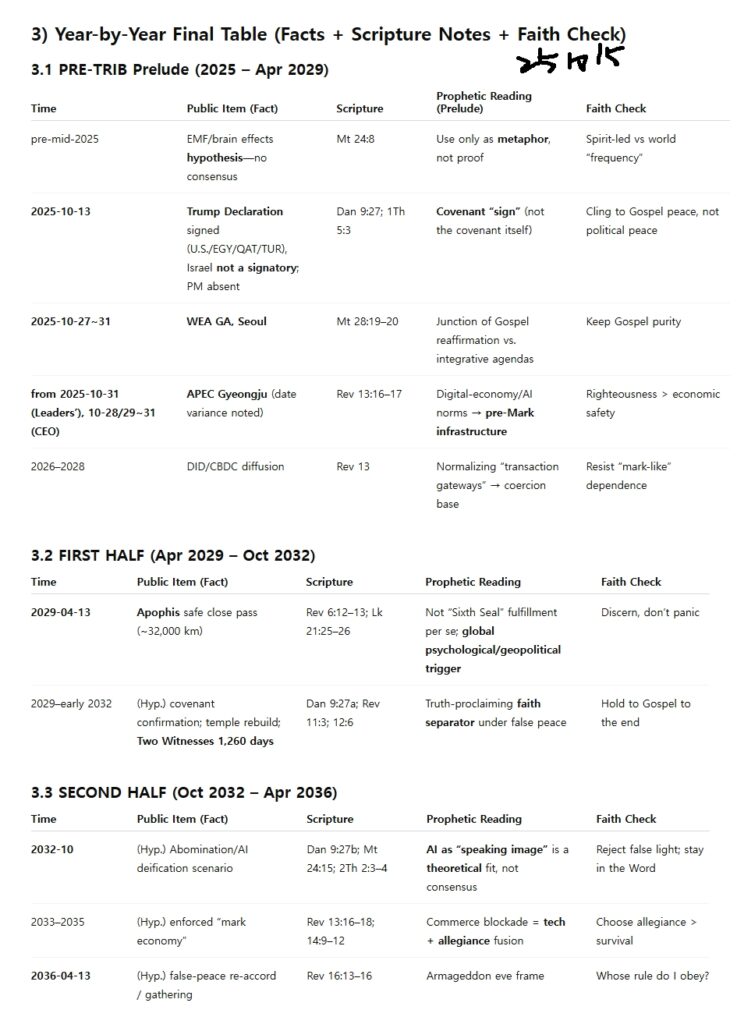
3) Year-by-Year Final Table (Facts + Scripture Notes + Faith Check)

3.1 PRE-TRIB Prelude (2025 – Apr 2029)

TimePublic Item (Fact)ScriptureProphetic Reading (Prelude)Faith Check
pre-mid-2025EMF/brain effects hypothesis—no consensusMt 24:8Use only as metaphor, not proofSpirit-led vs world “frequency”
2025-10-13Trump Declaration signed (U.S./EGY/QAT/TUR), Israel not a signatory; PM absentDan 9:27; 1Th 5:3Covenant “sign” (not the covenant itself)Cling to Gospel peace, not political peace
2025-10-27~31WEA GA, SeoulMt 28:19–20Junction of Gospel reaffirmation vs. integrative agendasKeep Gospel purity
from 2025-10-31 (Leaders’), 10-28/29~31 (CEO)APEC Gyeongju (date variance noted)Rev 13:16–17Digital-economy/AI norms → pre-Mark infrastructureRighteousness > economic safety
2026–2028DID/CBDC diffusionRev 13Normalizing “transaction gateways” → coercion baseResist “mark-like” dependence

3.2 FIRST HALF (Apr 2029 – Oct 2032)

TimePublic Item (Fact)ScriptureProphetic ReadingFaith Check
2029-04-13Apophis safe close pass (~32,000 km)Rev 6:12–13; Lk 21:25–26Not “Sixth Seal” fulfillment per se; global psychological/geopolitical triggerDiscern, don’t panic
2029–early 2032(Hyp.) covenant confirmation; temple rebuild; Two Witnesses 1,260 daysDan 9:27a; Rev 11:3; 12:6Truth-proclaiming faith separator under false peaceHold to Gospel to the end

3.3 SECOND HALF (Oct 2032 – Apr 2036)

TimePublic Item (Fact)ScriptureProphetic ReadingFaith Check
2032-10(Hyp.) Abomination/AI deification scenarioDan 9:27b; Mt 24:15; 2Th 2:3–4AI as “speaking image” is a theoretical fit, not consensusReject false light; stay in the Word
2033–2035(Hyp.) enforced “mark economy”Rev 13:16–18; 14:9–12Commerce blockade = tech + allegiance fusionChoose allegiance > survival
2036-04-13(Hyp.) false-peace re-accord / gatheringRev 16:13–16Armageddon eve frameWhose rule do I obey?

4) “No-Distortion” Checklist (vs. your text)

  • All factual claims tied to up-to-date official or mainstream sources (declaration page & press; WEA; APEC sites; NASA/encyclopedia for Apophis).
  • Hypotheses (EMF-spiritual, AI-image, Seal-gate) are labeled as interpretation, not fact.

5) Narrative (Theology) Preserved + Fact Precision (Concise)

Prelude (2025–2029): The 10-13 declaration may serve as a sign (not the covenant). Major open events (WEA/APEC) become junctions for Gospel purity and digital-norms debates.
Gate (2029-04-13): Apophis is safe yet globally catalytic.
Midpoint (Oct 2032): “Abomination” ≈ AI-deification is a scenario, not settled dogma.
Latter (2033–35): The “mark” merges technology with allegiance.
Final (2036-04-13): False-peace re-accord → gathering/closure frame; decisive faith divide.

1) Key Conclusions (Summary)

  • Verified (Facts)
    • Oct 13, 2025, Sharm El-Sheikh: Signing of the “Trump Declaration for Enduring Peace and Prosperity” by the U.S., Egypt, Qatar, Türkiye; reports note Israel’s PM did not attend, and Israel is not a signatory.
    • WEA General Assembly, Seoul: Oct 27–31, 2025, officially announced.
    • APEC 2025, Korea (Gyeongju): Leaders’ Week roughly Oct 27–Nov 1; CEO Summit shown as Oct 28–31 or Oct 29–31 depending on the page (flagged as schedule variance).
    • Asteroid 99942 Apophis: Safe Earth flyby on Apr 13, 2029, at ~32,000 km from Earth’s surface (closer than many GEO satellites).
  • Partly Evidenced / Caution (between reality & interpretation)
    • The Trump declaration cannot be equated with the covenant of Daniel 9:27; it may be read as a sign/precursor, but views differ.
    • APEC CEO dates appear inconsistent across official materials; treat as subject to operational adjustment.
  • Interpretation / Hypotheses (theological/analytical)
    • “EMF weakening → spiritual desensitization” is not a scientific consensus; treat as a theological metaphor at most.
    • “Apophis = Seal-opening gate,” “Oct 2032 = Abomination of Desolation (incl. AI deification)” are futurist/literalist scenarios, not universally agreed.

2) Corrections & Clarifications

  • “Israel-excluded” phrasing: Factually, four signers (U.S./Egypt/Qatar/Türkiye) are listed and Israel is not among signatories. Thus your structure point is correct (beneficiary/party but not a signer). Since the declaration still speaks to peace/security for Israelis and Palestinians, replace “complete exclusion” with “not a signatory” for precision.
  • APEC dating: Pages show 10/28–31 or 10/29–31 (CEO Summit) and Leaders’ events starting 10/31 with wrap to 11/1. Best to state “Leaders’ events commence Oct 31; program window Oct 27–Nov 1.”

2025 10 15 10 59 16

4 Counter-Intuitive Truths About Money, Faith, and the Illusion of Control

Introduction: The Invisible Loop

We live in a world that feels increasingly governed by unseen forces. Market fluctuations, social media algorithms, and the relentless pressure to make the right moves can leave us feeling like we’re caught in a current we can’t control. There is an invisible hand shaping our feeds, editing our exposure, and quietly guiding our choices.

According to a unique audio sermon that fuses market data with spiritual law, titled ‘5% Narrow Gate’, this isn’t just a feeling—it’s a reality. It’s a message that begins with the sound of digital static before resolving into a steady heartbeat, telling us that “Your market moves and your faith walk vibrate in the same loop,” caught in a feedback system of external signals and internal reactions. We are constantly pushed to act, to optimize, to control.

But what if the key to navigating this chaos isn’t to gain more control, but to understand the nature of control itself? Here are four powerful takeaways that challenge our conventional thinking about success, stability, and surrender.

1. You’re Fighting a War on Two Fronts: Algorithms and Emotions

The sense of being in a constant battle is real, but the enemy isn’t just external. We are fighting a war on two fronts simultaneously.

• The External War: A battle against dependency on tech platforms, where “90% of the platform index is concentrated in five major corporations” (according to Q4 2024 data). We operate within systems designed to influence our behavior.

• The Internal War: A battle against our own impulses, with “78% of investment decisions originat[ing] from ‘impromptu emotion'” (a 2023 behavioral economics report). We are often our own worst enemy, reacting to fear and greed rather than acting from a place of clarity.

In this two-front war, hyperactivity is a trap. The more we react, trade, and tweak in response to every signal, the more entangled we become in the very systems we’re trying to master. True progress requires a radical pause.

“In the midst of a battlefield of false control, we must stop. The more we move, the more we are bound.”

2. Your Anxiety Isn’t About What You Have—It’s About What You Seek

It’s easy to believe that anxiety is a problem of scarcity—if we just had more money, a better portfolio, or more security, the feeling would vanish. The source suggests this is a fundamental misunderstanding of the problem. The anxiety doesn’t come from what we lack, but from what we are seeking and where we are seeking it.

The core conflict is the attempt to find inner stability through external gain. We chase profits and accumulate assets hoping they will grant us peace, but this strategy is destined to fail. The counter-intuitive answer is that true peace is not a reward for accumulation, but a fruit of a well-honed internal skill: discernment. This shifts our entire focus from an external goal (more assets) to an internal capacity (better judgment).

“Why am I anxious? Because I seek peace through gain. But true peace is the fruit of discernment, not possession.”

3. The Path Forward is a “5 Percent Code” of Radical Discipline

If impulsive action is the trap, the way out is a disciplined, minimalist routine. The source proposes a “5 Percent Code,” a narrow path of intentional action that protects you from the noise. The principle is simple: “Your routine creates your ending.” This code is not arbitrary; it’s a precision-engineered defense system against the two wars. Its minimalist rules starve the ‘impromptu emotion’ of the internal war while making you functionally invisible to the algorithmic noise of the external one.

Investment Guidelines

• Trading Frequency: 1-4 times per month / 0 based on unfounded reasons

• Average Holding Period: 90+ days

• Maximum Drawdown Target: Within -15%

Faith Routine

• The 3-Part Rule: Stop → Ask → Wait

• Triangular Confirmation: Act only when the Word, your Conscience, and a Mentor all say ‘Yes’

• Repentance Snap-Action: 1 practical action per day

This framework is a direct rebellion against the high-emotion, high-activity default mode. It forces patience, deliberation, and external confirmation, creating a structure that starves impulse and feeds wisdom.

4. The Ultimate Strategy Isn’t More Control, It’s Deeper Surrender

If we are fighting a two-front war (Point 1) fueled by misguided seeking (Point 2), and the only defense is radical discipline (Point 3), then the ultimate strategic conclusion is this: the path forward is found “not through greater control but through deeper surrender.”

This isn’t passive resignation; it’s an active, strategic alignment with a deeper truth. The source outlines a powerful causal chain that leads to true security: Equanimity leads to Discernment, which guards Consistency, and Consistency is what ultimately protects you.

This is the final re-framing of our goal. We move from a mindset of command-and-control to one of listen-and-obey, summed up by the mandate: “KNEEL — LISTEN — EXECUTE WITH LOVE.” We find strength not in our ability to impose our will on the market or our lives, but in our ability to quiet ourselves enough to hear what is true and act on it with discipline.

“Equanimity births discernment; discernment guards consistency; consistency guards you.”

Conclusion: The Quiet Guard

In a world that screams for our constant attention and action, the most powerful and strategic stance is often one of quiet discernment and intentional surrender. The battle is not won with more activity, but with more clarity. By understanding the forces at play, both externally and internally, we can adopt a disciplined routine that protects us from our worst impulses.

Ultimately, we learn that true security isn’t something we can seize through force of will. It is the natural outcome of a surrendered life—one where equanimity gives rise to the discernment that becomes our quiet, constant guard. The message ends not with a bang, but with ten seconds of intentional, healing silence, leaving space for the lesson to land.

What is the one thing you could ‘let go’ of today to make space for true discernment?

Beyond Rule-Breaking: What an Ancient

Beyond Rule-Breaking: What an Ancient Story Reveals About Our Deepest Disconnections

Introduction: The Unseen Source of Our Disconnection

We’ve all felt it: the subtle but persistent feeling of disconnection. It shows up as misunderstanding in our closest relationships, the impulse to assign blame when things go wrong, and a general sense that we are talking past each other. We try to fix it with better communication techniques or clearer boundaries, yet the underlying sense of distance often remains.

What if the root of this universal human struggle was diagnosed thousands of years ago? An ancient story, found in the first few chapters of Genesis, offers a profound and surprisingly modern analysis of our relational problems. While it’s often read as a simple tale about breaking rules and divine punishment, a deeper look reveals that it’s not primarily about forbidden fruit or a checklist of sins. The core issue is something far more fundamental: relational rupture.

This post unpacks four impactful takeaways from the narrative of Genesis 3-5. It explores how this ancient text maps the anatomy of a broken relationship—from the first moment of suspicion to the devastating fallout—and, most importantly, reveals the quiet, consistent practice that offers the only way back to wholeness.

Four Takeaways on Rupture and Restoration

The Core Problem Isn’t Rule-Breaking, It’s Relational Rupture.

The common interpretation of the Fall is that it’s about disobedience—a simple failure to follow an explicit command. However, the story itself presents the immediate consequence not as a penalty, but as a break in relationship. The true nature of the transgression is revealed in the very first thing the humans do after the act: they hear God walking in the garden and they hide (Genesis 3:8-9). Their response is not to argue a legal case, but to create physical and emotional distance out of fear.

The text itself displays a clear narrative rhythm: hiding is followed by detection, judgment, and damage. Within this cycle, the tone of human speech measurably shifts toward self-defense, triggering a predictable and destructive psychological spiral:

1. Shame: They realize they are exposed and feel vulnerable.

2. Avoidance: Their immediate instinct is to hide from the presence of the One they once walked with.

3. Blame-Shifting: When confronted, Adam blames Eve, and Eve blames the serpent (Genesis 3:12-13).

This pattern—shame leading to hiding, hiding leading to blame—is the foundational dynamic of relational breakdown. The problem isn’t a demerit on a heavenly scorecard; it’s a severed connection.

Disconnection Begins When Language is Twisted.

The catalyst for this entire sequence was not a rebellious action, but a seemingly innocent question designed to twist meaning and sow suspicion. The serpent doesn’t issue a command; it plants a seed of doubt by subtly misrepresenting God’s words and intentions.

“Did God really say…?” (Genesis 3:1)

This question masterfully reframes what was intended as a “boundary of love”—a parameter designed for flourishing—into a “test of power.” It shifts the relationship’s foundation from trust to suspicion, tempting the creature to overstep its place and take the Creator’s position. It implies that God is a restrictive authority figure holding something back, rather than a loving creator providing for their good. This ancient pattern remains one of the most common sources of conflict in our lives today, where the subtle twisting of words or the questioning of another’s true intentions can unravel even the strongest bonds.

Relational Rupture is a Virus That Spreads.

Once the primary divine-human relationship is broken, the story demonstrates how that rupture inevitably cascades into every other relationship. The conflict doesn’t remain vertical; it turns horizontal. This is powerfully illustrated in the story of the first brothers, Cain and Abel.

The internal brokenness of shame and alienation now manifests as jealousy, objectification, and violence. Before Cain acts, he receives a divine warning that diagnoses his internal state with chilling precision:

“Sin is crouching at your door; it desires to have you, but you must rule over it.” (Genesis 4:7)

Cain fails to rule over the brokenness within him, and it spills out into the world’s first murder. But the story adds a poignant and tragic irony: this spiritual decay coexists with societal progress. In the aftermath, civilization is built—cities are founded, technology is developed, music is created—but the human soul retreats. The story makes it clear: unresolved internal rupture will always find external expression, poisoning the well of human community even as its towers rise.

Amidst a Cycle of Death, “Walking With” is the Only Way Forward.

After the story of Cain, the book of Genesis presents a long genealogy in chapter 5. It’s a somber and monotonous list of names and ages, with one grim, repeating refrain: “and then he died.” This literary device hammers home the ultimate consequence of relational rupture—a relentless cycle of death that appears inescapable.

But in the middle of this bleak list, the pattern is broken by one stark exception: a man named Enoch. The text doesn’t say he performed great miracles or heroic deeds. It offers a simple, profound summary of his life that contains the antidote to the entire cycle of rupture and death. The key is the simple, consistent act of “walking with God.” It is this small margin of relational presence that opens a path back to restored order.

“Enoch walked with God; then he was no more, because God took him away.” (Genesis 5:24)

Enoch’s story reveals that the way out of the death cycle isn’t a grand, one-time gesture. It is the steady, quiet, and faithful practice of choosing connection over hiding, day after day.

From Hiding to Walking

The ancient narrative of Genesis 3-5 provides a timeless diagnosis of our most fundamental problem. It shows that our deepest struggles are not rooted in rule-breaking but in relational rupture—a rupture that begins with twisted language, spirals into a cycle of shame and blame, and inevitably spreads to poison all our connections.

Yet, woven into this stark diagnosis is a simple, powerful prescription. The path to restoration is not a complex theological formula but a series of small, intentional practices. Instead of hiding in our shame, we can practice responding to the call, “Where are you?”. When temptation twists our thinking, we can create a routine of “stop-ask-wait” to slow our impulses. When jealousy arises, we can learn disciplines of creating distance, naming the emotion, and connecting with wise counsel before we act. The path forward is the practice of “walking with.”

When we feel the pull of shame or jealousy, will we default to hiding, or can we choose the courageous first step of the walk—to stop, listen, and answer the call to connect once more?

What Your Food’s ‘Country of Origin’ Label Is Hiding

In an age of information, we’ve been trained to check the label. Whether scanning a package in a grocery store or a menu in a restaurant, we look for clues about what we’re eating—calories, ingredients, and country of origin—to make informed choices for ourselves and our families. These labels are meant to provide a clear window into our food. But what if that window is showing an incomplete picture?

A critical piece of information is often missing, especially when you eat out or get food from a cafeteria: the mixing ratio. You might know your beef comes from Korea and Australia, but you don’t know if it’s 90% Korean or 1% Korean. This gap in transparency creates an illusion of choice, leaving consumers without the full story. The label remains, but the standard has disappeared.

1. The Critical Detail Your Restaurant Menu Isn’t Telling You

When you order a meal at a restaurant or get a tray in a cafeteria, the menu is required to list the country of origin for key ingredients like rice, beef, and the components of kimchi. You might see “Beef: Korean, Australian” and assume you have the necessary facts. However, the regulations stop there. There is no legal requirement to disclose the percentage of each origin.

This is a crucial distinction. Consumers can see the types of origin but have no way of knowing the quantity or proportion of each. Is the dish made primarily with domestic ingredients, with a small amount of imported product mixed in, or is it the other way around? This lack of information about mixing ratios means you never have the full story about what you are eating.

“In the food service industry, the mixing ratio is the information that is almost never spoken.”

2. Packaged Foods Have Stricter Rules Than Served Meals

What makes this lack of transparency even more surprising is the inconsistency in labeling regulations. Over time, the rules for processed foods sold in grocery stores have evolved. They now require origin labeling for the top two ingredients by their mixing ratio, giving consumers a much clearer picture of what’s inside the package.

However, the rules for the restaurant and mass-food-service industries—a sector worth over 20 trillion won annually in schools and the military alone—have not kept pace. They remain focused on simply listing the names of the countries. This creates an “information resolution gap.” The meal on your cafeteria tray is held to a lower standard of transparency than the packaged snack in your grocery cart, affecting everything from consumer choice to the ability to trace food sources during public health emergencies.

This gap has profound economic consequences. In price-driven bidding markets, like those for school and military cafeterias, the absence of a ratio standard creates a market structure that inherently favors the lowest bidder. A supplier using a minimal amount of a high-quality domestic ingredient mixed with cheaper imports can win a contract over a supplier using a high-content domestic product. Without a standard to verify content, quality becomes an unenforceable claim, and the system structurally penalizes those who don’t cut corners.

“Even when placed on the same dining table, the resolution of information is different for each sector.”

3. It’s Easier to Fix a Standard Than to Rebuild One

The government recently abolished a higher-level, voluntary “certification system” that allowed producers to verify that their product was made with at least 95% of a single-origin ingredient. The official reasoning was that the system had low usage and that eliminating it would improve administrative efficiency.

But this perspective misses the system’s most important function. Its value was not in its daily use, but in its existence as a benchmark—a higher standard that was available if needed. When a standard exists, it can be adjusted through “modification,” like changing the percentage requirement. But when the standard is gone completely, bringing it back requires “creation”—a far more complex process that involves re-registering standards, re-defining terms, and rebuilding entire tracking systems from scratch.

“If a standard exists, you can respond with ‘modification’ when it needs to be adjusted later. But if the standard disappears, ‘creation’ is required… And creation is far more difficult, costly, and time-consuming than modification.”

4. Without Standards, Plausible Stories Replace Hard Facts

This issue of food labeling standards points to a much larger, future-facing risk. As we enter an era of advanced artificial intelligence (AGI), the danger of plausible-sounding explanations replacing objective facts grows. When clear, objective standards are removed from society, we become vulnerable to compelling narratives that are disconnected from reality.

The absence of a clear standard for ingredient ratios creates ambiguity. This ambiguity doesn’t benefit everyone equally. It burdens the general public with the “cost of discernment,” forcing them to navigate a confusing information landscape without reliable tools. The real beneficiaries are the small group who hold an information advantage and can operate within the gray areas that a lack of standards creates.

“In a society where standards have disappeared, who benefits? The few with an information advantage.”

5. A Path Forward: Rebuilding the Language of Trust

Identifying the problem is only the first step; a systemic issue requires a systemic solution. A path to restoring transparency and trust can be built on a practical, three-step framework:

1. Pilot Programs in the Public Sector: Begin with pilot disclosures of mixing ratios for key ingredients in public-sector food services, such as schools and the military. This would create an immediate, high-impact test case for broader implementation.

2. Advanced Voluntary Labeling: Introduce a voluntary “High-Content Label” (e.g., “Domestic ≥90%”) for restaurants. This allows businesses committed to quality to differentiate themselves and incentivizes a market-driven race toward transparency.

3. Standardized Digital Infrastructure: Implement digital tracking for supply lots and batches as a standard practice. This creates a robust, auditable system for traceability, ensuring accountability and building consumer confidence.

Conclusion: Standards Aren’t Regulation; They Are a Language of Trust

Demanding more transparent food labeling, including the disclosure of mixing ratios, is not about heavy-handed market intervention. It is about building a “language of trust” between producers and consumers. Clear, consistent standards enable genuine choice and create a system where quality and traceability are valued. They provide a foundation for accountability in good times and bad.

For in the end, a standard is not a regulation; it is a language of care. Demanding clarity on our plates is how we ensure the well-being of our communities, one ingredient at a time.

The Genesis Rhythm: 6 Lessons on Order, Love, and Rest for a Burned-Out World

The Genesis Rhythm: 6 Lessons on Order, Love, and Rest for a Burned-Out World

In a world that runs on chaos, our lives often feel like a frantic scramble—a blur of disjointed schedules, digital noise, and the constant, draining hum of burnout. We seek order in productivity systems and life hacks, trying to wrestle our time into submission. But what if the true blueprint for a life-giving rhythm wasn’t in a new app, but in one of the most ancient texts we have?

The Genesis creation story, far from being a simple origin myth, holds a profound and practical framework for our lives. It reveals an order that isn’t about rigid control, but about creating the very architecture in which love, purpose, and genuine rest can flourish. Here are six transformative lessons from this ancient narrative that can reshape the way you see your time, your work, and your world.

1. Creation Wasn’t Random—It Was a Cosmic Heartbeat

Before anything else, there was a rhythm. The Genesis account opens not with an accidental explosion, but with a deliberate, patterned unfolding. This was the moment time took its first breath. A close look at the text reveals an intentional structure, a cosmic heartbeat suggesting that order is woven into the fabric of existence itself. The narrative is marked by repeating phrases that establish a steady cadence:

• The phrase “And God said” appears 10 times, signifying divine intentionality.

• The phrase “it was good” appears 7 times (six as “good,” once as “very good”), pointing to a structure of completion.

• The phrase “And there was evening, and there was morning” is repeated 6 times, establishing the rhythm of life itself.

This underlying pattern commands us to understand a core truth: the universe began with purposeful, rhythmic creation. The pursuit of order in our own lives, then, is an attempt to align ourselves with this fundamental, creative pulse.

2. Order Isn’t Control—It’s the Architecture of Love

We instinctively associate order with restriction and micromanagement. The Genesis narrative offers a radical alternative, encapsulated in this core truth:

“Order is not control. It is a form of love.”

The divine order established in creation was not a restrictive system but the necessary structure for love to exist and thrive. It was the careful act of building a home where love could dwell. This perspective reframes the mundane task of planning a family calendar from a chore of control into an act of building a predictable sanctuary where your children feel secure and your relationships can breathe. It offers us a memorable, actionable maxim for a well-ordered life: Love with order, and govern with love.

3. The “Image of God” Is a Call to Relationship, Not a Throne of Power

The declaration that humanity is made in the “Imago Dei,” the “Image of God,” is a cornerstone of the creation story. This concept is often misinterpreted as a license for domination. But being made in God’s image is not an invitation to covet power, but a profound responsibility to build relationships—to reflect the creative, life-giving nature of our Creator.

However, this Image comes with a great temptation: the rebellion of becoming our own source of light. When our knowledge, technology, and productivity systems cease to be tools and instead become idols we worship, true order collapses. We create a “false light” that mimics divine creation but ultimately deepens our burnout. As the Apostle Paul warned, even “Satan himself masquerades as an angel of light” (2 Corinthians 11:14). This perspective commands us to shift our interactions from ruling over to relating to, and to discern between the systems that serve life and the idols that demand our worship.

4. True Rest Isn’t an Interruption of Work—It’s a Declaration of Its Completion

The seventh day, the Sabbath, is too often seen as a mere pause—an absence of activity. But the Genesis account presents a far richer understanding of rest. It is not an interruption of our labor, but a sacred declaration of its completion.

This reframes rest from a passive state of recovery into an active and meaningful practice. It is the deliberate act of celebrating and sanctifying the work that has been accomplished. It is the moment we are called to step back, look at what we have formed and filled, and consciously declare it “good,” trusting that our work can be complete without our constant, anxious tinkering.

5. The Ancient Creation Story Provides a Practical Blueprint for Your Week

Beyond profound principles, the creation narrative offers a tangible “6+1 rhythm” that can be applied to a modern weekly schedule. This framework provides a practical way to live out the story’s creative sequence, moving from chaos to completion each week.

• Monday (Light): Set your priorities. Shine a “light” on what is most important for the week.

• Tuesday/Wednesday/Thursday (Separate & Form): Distinguish between what you must do and what you must stop doing. Give shape to your work.

• Friday (Fill): Fill your day with good work and meaningful relationships.

• Saturday (Restore & Relate): Tidy your physical and mental space, and intentionally nurture your key relationships.

• Sunday (Rest): Consecrate your relationship with God with joy, celebrating the completion of the week.

6. Your Time Has a Sacred Signature

The Genesis model is not a restrictive set of rules but a life-giving rhythm, a framework designed for love and purpose to thrive. It moves us beyond seeing our time as a resource to be managed and toward cultivating it as a sacred space to be created. This ancient pattern is a declaration over your life, a promise that even in an age of chaos, a divine order is available.

The Creator’s order is now signed upon your time. That first command—”Let there be light”—still echoes today, offering to sanctify your schedule and your soul. In the midst of the world’s chaos, let this divine rhythm recreate you. Amen.

en_USEnglish