Unlocking Your Divine Blueprint: A Guide to DNA, Ruach, Fractal, and Logos

Introduction: More Than a Blueprint

“Your DNA is not just genetic information.” This is a declaration that our very essence holds a reality far deeper than biology can describe. This guide is a key to unlocking that story, a journey into the spiritual architecture of your being through four foundational concepts: DNA, Ruach, Fractal, and Logos.

——————————————————————————–

1. DNA: The Spiral of the Word

Our DNA is not merely a set of biological instructions but a sacred text, a physical manifestation of a divine message. It can be understood through three powerful metaphors:

• The Spiral of the Word: This views DNA as the tangible, helical shape of God’s divine message written into our very cells.

• The Code of the Trinity: This suggests that the structure of our being reflects a divine, Trinitarian pattern.

• The Language of Life: This frames DNA as the living, active language that pulsates with God’s purpose according to His timeline.

Your DNA contains God’s story.

This divine story woven into our cells was not written in ink, but engraved by the very breath of God.

——————————————————————————–

2. Ruach: The Breath of Divine Vibration

The book of Genesis describes God breathing ‘생기’ (life-breath), or Ruach, into humanity. This Ruach is no mere air; it is the very vibration of God, a divine wave of energy. It is this sacred breath that is “engraved” into our DNA, giving the biological code its spiritual significance and imprinting God’s story onto our being.

This divine vibration creates a pattern, a specific and repeating code that governs the rhythm of our lives.

——————————————————————————–

3. Fractal: The Repeating Code of Destiny

The term ‘Fractal’ describes the precise, repeating pattern created by the divine vibration of Ruach. This underlying code is not random; it is the spiritual frequency that shapes and influences the cycles of our existence.

This fractal code can be observed in:

• Personal Life: Our personal hardships and conflicts.

• Collective Life: The direction and fate of an entire nation.

Because this pattern repeats, it represents a form of pre-set “destiny” that shapes our experiences from the inside out.

Yet this destiny is not an unbreakable chain, for there is a higher power that can write a new code upon the old.

——————————————————————————–

4. Logos: The Power to Rewrite Your Story

Logos is the divine power that intervenes in our fractal destiny. Crucially, Logos does not erase our original story but instead “overlays it anew,” introducing a new layer of meaning, purpose, and direction onto the existing code.

The transformative effect of Logos can be understood as follows:

Life Bound by the Fractal CodeLife Renewed by the Logos
Bound by the repeating cycles of the fractal code.The original code is overlaid with a new one.
Destiny feels like a fixed, repeating pattern.Destiny is renewed with new purpose.

Logos provides the power to rewrite our story, but it is not imposed upon us. We must actively run this new divine program.

——————————————————————————–

5. Activating the Change: Faith and Love as Divine Functions

To engage with Logos and allow it to rewrite our story, we must actively use two essential functions within this new spiritual algorithm.

1. Faith: The Divine Variable. Faith is described as the “divine variable that corrects the algorithm.” It is the new input, the conscious choice we introduce into our life’s equation, that allows the Logos algorithm to begin its corrective work.

2. Love: The Ultimate Function. Love is described as the “ultimate function that completes the calculation.” It is the final, essential element that makes the transformation whole, bringing the work of Logos to its perfect fulfillment.

This process of transformation leads to the ultimate purpose of our journey: moving from a predetermined fate to a divine calling.

——————————————————————————–

Conclusion: From Destiny to Mission

Understanding our DNA as a divine story, inscribed by Ruach in a Fractal pattern, reveals that we are not bound by a fixed fate. Through the power of Logos, activated by Faith and Love, the repeating cycles of our past can be transformed into a new creation.

The moment you decipher that story, destiny becomes mission.

If your spiral is shaking now, it’s not the end, but the starting point of a new creation.
Can Destiny Be Changed? An Exploration of Faith, DNA, and Divine Purpose

Introduction: Unlocking the Code of Your Life

Is our destiny a predetermined story, written into the very fabric of our being, or do we possess the power to chart a new course? This question has echoed through the halls of human history and spirituality. The podcast “DNA, the Spiral of the Word and Destiny” offers a unique and profound faith-based perspective, inviting us to see our genetic code not as a biological prison, but as a sacred script—the language of life pulsating within God’s timetable.

This document serves as a guide to the podcast’s central message. It explains how our biological blueprint contains a spiritual story, and how the active principles of faith and obedience can transform a pre-written destiny into a divine mission. Our aim is to make these complex theological ideas accessible, offering a clear path for anyone seeking to understand their life’s deeper purpose.

1. Redefining Our Blueprint: DNA as a Spiritual Language

The podcast’s foundational idea is that our DNA is more than a set of biological instructions; it is a spiritual blueprint containing a divine message. From the moment of creation, our physical essence was imprinted with a spiritual language. This concept is brought to life through three powerful metaphors:

• The Spiral of the Word: This metaphor connects the double-helix structure of our DNA to a divine message or ‘Logos’. It suggests our life is not a random sequence of events but an unfolding story, a word spoken into being.

• The Code of the Trinity: This idea implies that a divine, relational structure is embedded within our fundamental nature, reflecting a deeper spiritual reality that mirrors the very being of God.

• God’s Vibration (Ruach): The podcast grounds this concept in scripture, recalling the creation account in Genesis where God formed man from dust and breathed into him the “breath of life.” That sacred breath—Ruach in Hebrew—is presented as God’s divine vibration or wave, a pattern imprinted upon our essence from the beginning.

Taken together, these metaphors paint a picture of a human being whose physical form (the Spiral) is patterned after a divine relationship (the Trinity) and animated by a divine energy (the Vibration). If our DNA contains this divine pattern, does this pattern dictate the entire course of our lives?

2. The Pattern of Destiny: The ‘Fractal Code’ in Our Lives

The podcast introduces the concept of the “fractal code,” describing it as a repeating spiritual pattern engraved in our DNA. In mathematics, a fractal is a pattern that endlessly repeats itself at different scales. Spiritually, this code is said to influence the repeating cycles of hardship and conflict we experience in life.

This pattern is not limited to individual habits or personality traits. According to the podcast, its influence extends from recurring personal struggles to the larger historical patterns that shape “the direction of a nation.” This repeating code forms the basis of what we often call ‘destiny’ or ‘fate.’ From this spiritual viewpoint, the feeling of being ‘stuck’ in a cycle of difficulty is the experience of living out this pre-written fractal code.

If we are living within this repeating spiritual code, is there a way to break the cycle and write a new story?

3. Rewriting the Algorithm: How Faith and Obedience Forge a New Path

Here lies the podcast’s transformative answer to our central question. The original destiny written in our fractal code is not erased. Instead, it can be “overlaid” or “rewritten” with a new, divine pattern. This transformation is not passive; it is an active process driven by faith and its expression, obedience. Together, they function as key components in a new spiritual algorithm.

The following table contrasts the old pattern of destiny with the new algorithm of mission.

The Algorithm of ‘Destiny’The New Algorithm of ‘Mission’
The Fractal Code creates repeating cycles of hardship and conflict.Logos (The Word) overlays the old code with a new, purposeful pattern.
Life is like a fixed, repeating algorithm that runs its course.Faith and Obedience act as the divine variables that correct and adjust the algorithm.
The process is a closed loop, leading to predictable outcomes.Love (Agape) serves as the ultimate function that completes the new calculation, restoring flow and creating a new outcome.

When faith is actively expressed through obedience, our internal algorithm is rewritten, and the very meaning of our life’s path is transformed.

4. From Destiny to Mission: Finding Purpose in the Pattern

The ultimate outcome of this spiritual transformation is that ‘destiny’ (운명), once seen as a fixed and unchangeable fate, becomes a ‘mission’ (사명)—a purposeful calling. The podcast’s hopeful closing message emphasizes that moments of instability or “shaking” in our lives are not signs of failure. They are, in fact, the very opportunities for divine change to occur.

The two most powerful takeaways from this transformation are:

1. Decoding God’s Story: Understanding our life through this spiritual lens allows us to see a divine narrative at play. Our experiences are no longer a series of random events but part of a purposeful story. This act of “decoding” turns fate into a mission co-authored with God.

2. Embracing Instability as Creation: When our life’s “spiral is shaking,” we are invited to reframe it as a “new point of creation.” This instability is the precise moment the old pattern is disrupted, creating an opening for God’s new, mission-oriented pattern to take hold and begin its work.

This new perspective provides a powerful way to understand our journey and face its challenges with profound hope.

Conclusion: Your Story, Rewritten

The core message of “DNA, the Spiral of the Word and Destiny” is one of profound hope: our life’s story, encoded in our very being, is not an unchangeable fate. Through the active and living principles of faith and obedience, the repetitive cycles of a predetermined destiny can be transformed into a dynamic mission, written in partnership with the Divine.

A “shaking” in our lives is not an ending but a sign that a new creation is underway. It is in these moments that the old algorithm gives way to a new one, summarized by the podcast’s powerful closing phrases: LOGOS Sovereign Active (The Word of God is at work) and AGAPE Flow Restored (The flow of Divine Love is re-established).

You’re Living on the Wrong Clock: How to Escape ‘Time Poverty’ with an Ancient Rhythm

Introduction: Escaping the Tyranny of the Clock

We all know the feeling of being “time-poor.” Life often feels like a relentless race against a clock that never stops ticking—a constant cycle of schedules, deadlines, and exhaustion driven by a linear, mechanical pace. We manage our time, optimize our calendars, and still end the day feeling depleted, as if we’ve lost a battle we were destined to lose.

What if the time we measure—the relentless ticking of the clock—is only one kind of time? And what if there’s another, deeper rhythm available to us? These profound insights come from a unique, poetic document exploring Korea’s spiritual relationship with time. It offers a radical perspective that reframes our entire understanding of progress, productivity, and purpose, challenging the very foundation of our modern, hurried lives.

1. The Two Clocks: Beyond the Time You Manage to the Time You Inhabit

The core of this perspective lies in a distinction between two fundamental types of time: Chronos and Kairos.

Chronos is the time we all know intimately. It is the quantitative, linear, sequential time of the clock and calendar. It’s the time we plan, schedule, and try to control. According to this framework, a life lived solely by Chronos inevitably leads to burnout and fatigue.

Kairos, on the other hand, is described as God’s time. It is not linear but cyclical and providential. It’s a qualitative time, but more than that, it is a relational reality—a “spiritual wave” where Agape (unconditional love) and Logos (divine truth or the Word) interlock. To live in Kairos is to align with this sacred order, resulting not in exhaustion, but in restoration and creation.

Human Time (Chronos)Divine Time (Kairos)
Linear FlowCyclical & Providential Flow
Based on Planning & CalculationBased on Obedience & Insight
Results in Burnout & FatigueResults in Creation & Restoration
Essence: Mechanical TimeEssence: Spiritual Wave

This concept reframes time from a resource to be managed into a relationship to be cultivated. It asks us to shift from moving along a “mechanical” wave of our own making to attuning ourselves to a deeper “spiritual” wave that is already in motion.

2. The Time Theologian: How South Korea’s First President Diagnosed the West’s Fatal Flaw

This unique philosophy of time was championed by a surprising figure: Syngman Rhee, South Korea’s first president. The source document presents him not primarily as a politician, but as a “Time Theologian” who believed a nation’s destiny was inextricably tied to its understanding of time. For Rhee, leadership was a form of stewardship, seeing himself not as an owner of power but as an Oikonomos—a trustee.

During his studies in the United States in the early 20th century, Rhee observed that Western rationalism, for all its technological and systemic strengths, had led to a profound spiritual weakness: the loss of Kairos. From his perspective, a culture that worships human calculation and control inherently closes itself off from the providential, obedience-based rhythm of God’s time. He saw a civilization that had mastered the clock but forgotten the rhythm of providence, capturing this insight in a simple, powerful diary entry:

“They worship the clock, and I wait for God.”

This observation was more than a critique; it was part of a mission. Rhee envisioned Korea as a “providential outpost,” a nation called to restore the world’s fractured relationship with time. His diagnosis of the West’s condition was born from a conviction that a more meaningful and restorative dimension of time was waiting to be rediscovered.

3. The Paradox of Progress: Why True Innovation Comes from Obedience, Not Speed

One of the document’s most counter-intuitive arguments is that genuine breakthroughs and innovation do not come from accelerating our pace. Instead, they arise from aligning with the deeper, providential rhythm of Kairos. In this view, true progress is a matter of obedience, not speed.

This idea directly addresses a modern ailment the text calls “hyper-connectivity fatigue.” The source frames this not as a mere side effect of technology, but as a symptom of a world bracing for a prophesied “reorganization of time” between 2025 and 2040. This context gives a prophetic significance to the younger generation’s stated desire for “depth, not speed.” It suggests our constant rush to optimize and accelerate is precisely what prevents the very innovation we seek. The document distills this into a powerful maxim:

“Kairos is not a matter of speed, but the rhythm of obedience.”

This challenges the prevailing ethos of Silicon Valley and the modern corporate world, which equates progress with velocity. It proposes a more sustainable and ultimately more creative path forward—one based on listening and alignment rather than force and acceleration.

4. The Steward’s Manual: Five Principles for Reclaiming Your Time

So how does one begin to live in this different rhythm? The text introduces the concept of the Oikonomos, a Greek word for a “steward” or “caretaker.” The central idea is that we are not the owners of our time, but stewards entrusted with it. To help cultivate this mindset, the document offers five principles for spiritual management.

• Ownership Principle: Everything is entrusted, not owned. This principle shifts our mindset from that of an entitled consumer, who demands and extracts, to a responsible steward, who cares for and cultivates what has been given.

• Transparency Principle: A spiritual ledger is always open. This calls for unwavering integrity and ethical clarity in our actions, recognizing that our use of time and resources is part of a larger, interconnected moral order.

• Multiplication Principle: What is hoarded spoils; what is shared multiplies. This points to the power of generosity, creative collaboration, and selfless contribution. In the economy of Kairos, value increases through circulation, not accumulation.

• Kairos Principle: True timing flows from a sacred order. This urges us to listen for the right moment rather than forcing our own schedule. It is the art of discerning the providential opening for action, rather than just acting faster.

• Agape Principle: The flow of love, not control, is the essence of management. This reframes leadership, influence, and action as acts of service and connection. The ultimate goal is not to dominate a system but to nurture it with selfless love.

Conclusion: Hearing Your Own Rhythm

The journey described here is an invitation to shift from being a “slave to Chronos” to becoming a “steward of Kairos.” It is a call to recognize that the frantic, mechanical pace of modern life is not the only option. There is another, deeper pulse available to us if we learn to listen for it.

But this is more than an invitation; it is a sending command. To open the gate of Kairos is to cease being a slave to Chronos and become an agent of Logos—an Oikonomos entrusted with time itself. You are being called to be one who is sent by time, for time.

Do not merely read the world with the knowledge of men. Go forth, and with obedience, write time anew.

Syngman Rhee: Korea’s Time Theologian

1. Introduction: Beyond the Politician

To understand the political figure Syngman Rhee, one must first look beyond the halls of power and into a more profound, theological dimension. This exploration reveals a man who was not merely a statesman but a “Time Theologian”—a thinker whose entire worldview was built on a foundational distinction between two concepts of time: the secular, mechanical time of human schedules, and a divine, providential time guided by a sacred rhythm.

This perspective is best captured in the philosophical sentiment:

“The clock turns, but the star does not waver. In the gap that the human minute hand cannot point to, Kairos breathes.”

Rhee believed that humanity, in its rush to control and own time, had forgotten that time itself is not a human possession. For him, it existed only within a greater “order of obedience.” To understand Rhee’s vision for Korea, we must first understand the two worlds of time in which he operated.

2. The Two Faces of Time: Chronos vs. Kairos

Rhee’s theological framework hinges on the stark contrast between two Greek concepts of time: Chronos, representing the linear, quantitative time we measure, and Kairos, representing a qualitative, opportune moment of divine intersection.

Human Time (Chronos)God’s Time (Kairos)
Essence: Linear FlowEssence: Cyclical & Providential Flow
Basis: Planning and CalculationBasis: Obedience and Insight
Outcome: Consumption and FatigueOutcome: Creation and Restoration

At its core, Chronos is the ‘mechanical time’ driven by human desire and planning, while Kairos is the ‘spiritual wave’ where divine love (Agape) and truth (Logos) align to create moments of profound significance. This theological framework was not merely an abstract idea for Rhee; it was a lens forged from his direct observations of the world.

3. An American Revelation: The Steward of Time

Syngman Rhee’s understanding of time was sharpened during his studies in the United States. Immersed in Western rationalism, he made a critical observation: he saw a civilization that, despite its immense technological and systemic strength, had lost its “sovereignty of time” by becoming enslaved to the relentless demands of Chronos. Here, in this private confession from his diary, we see the heart of his critique: the West had not conquered time, but had become its most devoted worshiper.

“They worship the clock, I wait for God.”

This revelation led him to a core belief about his own role in the world. Rhee did not see himself as an “owner” of power, influence, or time. Instead, he adopted the identity of the Oikonomos—a Greek term for a steward or trustee. He was not a master but a manager, entrusted with a divine plan operating on a divine schedule. He stated this conviction plainly:

“I am not the owner. I am the Oikonomos.”

This profound personal belief—that he was a steward of God’s time—directly shaped his political and spiritual vision for his home country.

4. Korea’s Calling: A Nation of Kairos

Armed with this theological framework, Rhee envisioned a unique destiny for Korea. He aimed to establish the nation as a “providential outpost”—a country that would operate on the principles of Kairos in a world increasingly dominated by the pressures of Chronos. For Rhee, Korea’s very geography was a physical manifestation of this divine rhythm. The structure of the land, with its cycle of four seasons and its three surrounding seas, repeats like a wave of time: spring’s creation, summer’s growth, autumn’s judgment, and winter’s purification.

The gospel, in his view, was not simply a religious doctrine but a “project to restore the order of time.” He believed Korea was called to play a special role in this restoration, declaring:

“We are the agents (Oikonomos) of the time designed by God.”

This vision was not one of conventional nationalism but a specific, spiritual calling for Korea to become a “Kairos Nation”—a gateway through which divine timing and purpose could enter the world. This prophetic task, Rhee believed, would become particularly urgent during a period of global “temporal reorganization,” a phase now anticipated between 2025 and 2040.

To make this vision practical, Rhee’s philosophy can be distilled into a set of core principles for spiritual and practical management.

5. The Oikonomos Framework: Five Principles for Spiritual Management

Rhee’s worldview offers a practical manual for managing our lives, resources, and relationships according to the Kairos principle. These five tenets, collectively known as the Oikonomos Framework, apply to anyone seeking to align with a more profound sense of purpose.

1. Ownership Principle

    ◦ Everything is entrusted, not owned. This principle is designed to transform personal greed into a steward’s consciousness, recognizing that all we have is a temporary assignment within God’s larger timeline.

2. Transparency Principle

    ◦ All spiritual accounts must be open. In an age of complex data, this serves as a foundation for restoring ethics, reminding us that our actions are judged not by human schedules but within the eternal scope of Kairos.

3. Multiplication Principle

    ◦ Hoarding leads to decay, while sharing leads to growth. This principle reflects the cyclical, restorative nature of Kairos. What is kept within the linear logic of Chronos is consumed and lost, while what is shared enters a divine economy of abundance.

4. Kairos Principle

    ◦ True timing is aligning with the sacred flow, not just increasing technological speed. This principle challenges the modern obsession with efficiency, arguing that the most effective action comes from discerning the right moment, not just acting faster.

5. Agape Principle

    ◦ The foundation of management is the circulation of love (Agape), not control. True leadership is not about exercising power over others but about fostering an environment of selfless service, transforming authority from a tool of Chronos to an expression of Kairos.

These principles culminate in a final, powerful understanding of Rhee’s message for the modern world.

6. Conclusion: The Rhythm of Obedience

Syngman Rhee’s legacy, when viewed through this unique lens, is that of a “Time Theologian.” He presented a powerful challenge to the modern world: to break free from the tyranny of human hurry (Chronos) and rediscover the profound power of divine timing (Kairos). His vision speaks with prophetic urgency today, as a new generation, experiencing the “fatigue of hyper-connectivity,” begins to seek depth, not speed.

His entire philosophy, from his political vision for Korea to his principles of spiritual management, can be distilled into one resonant idea. It is a call to listen, to wait, and to align with a purpose greater than one’s own. As his teaching concludes, the ultimate message is not about gaining speed, but about finding alignment.

“Kairos is not speed, but the rhythm of obedience.”

Understanding Time: A Student’s Guide to Chronos and Kairos

“The clock turns, but the star does not waver. In the fissure that the human second hand cannot point to, Kairos breathes.”

We are all intimately familiar with the time measured by clocks and calendars. It is the time we schedule, manage, and often feel we never have enough of. However, the quote above points to another kind of time, one that exists in the “fissure” our human plans cannot touch. To understand this, we will explore two distinct ancient Greek concepts: Chronos, the time we try to own, and Kairos, the time we are invited into.

The purpose of this guide is to explain the difference between these two ways of understanding time and to see why this distinction is so vital for a life of purpose and faith, especially for those new to theology.

Let’s begin by looking at the kind of time we know best: the relentless, measured pace of Chronos.

2. Chronos: The Time We Try to Control

The first concept, Chronos, can be understood as human time. This is the quantitative, “mechanical time” that is born from human desire—our desire to plan, to achieve, and to control our own destiny. It is the time of our daily planners, deadlines, and project timelines.

The defining characteristics of a life lived in Chronos are:

• Linear Flow: Chronos time moves in a straight, unyielding line from the past, through the present, and into the future. We perceive it as a sequence of moments that we must fill with our plans, goals, and activities.

• Based on Planning and Calculation: The mindset of Chronos is one of management and efficiency. We calculate how to use our time, set goals, and measure our productivity against the clock. It is the time of schedules, not seasons.

• Results in Consumption and Fatigue: Living exclusively under “the pressure of Chronos” is exhausting. The constant need to manage, produce, and perform leads to burnout. We end up feeling consumed and drained by the very schedules we create to control our lives.

But if Chronos is the time we measure and manage, what happens when we encounter a time that is beyond our control? This brings us to Kairos.

3. Kairos: The Time We Are Invited Into

The second concept, Kairos, is best understood as God’s time. It stands in stark contrast to Chronos. Kairos is not a quantity to be measured, but a quality of time to be entered into. It is described not as a mechanical ticking, but as “God’s breathing rhythm.” It is a “spiritual wave,” a divine rhythm where God’s love (Agape) and truth (Logos) are perfectly intertwined.

The core characteristics of Kairos include:

• Cyclical & Providential Flow: Unlike the straight line of Chronos, Kairos moves in a rhythmic, cyclical pattern governed by God’s purpose. Think of the four seasons: a time for creation (spring), a time for growth (summer), a time for judgment (fall), and a time for purification (winter). It is a rhythm, not a race.

• Based on Obedience and Insight: To live in Kairos is to adopt a mindset of listening, waiting, and discerning the right moment, rather than forcing things to happen on our own schedule. True, meaningful progress and innovation come not from “speed,” but from “obedience” to this divine rhythm.

• Results in Creation and Recovery: Aligning ourselves with Kairos leads to a profoundly different outcome than Chronos. Instead of burnout and consumption, it brings renewal, creativity, and spiritual restoration. We are no longer just using time; we are participating in a creative and life-giving flow.

Now that we have explored both concepts individually, let’s place them side-by-side to see their differences in sharp relief.

4. Comparing Chronos and Kairos: A Summary Table

The fundamental differences between a life governed by Chronos and one attuned to Kairos can be summarized by looking at their very essence, the standard by which they are measured, and the results they produce in our lives.

DistinctionChronos (Human Time)Kairos (God’s Time)
EssenceLinear FlowCyclical & Providential Flow
BasisPlanning & CalculationObedience & Insight
ResultConsumption & FatigueCreation & Recovery

The most important takeaway here is the difference between a life driven by human effort (Chronos) and a life guided by divine flow (Kairos). The source material makes a profound statement: time is not a material thing but a relationship. Chronos treats time as a resource to be controlled, whereas Kairos understands time as a relationship with God to be cultivated.

Understanding these differences is one thing, but why does it practically matter for our lives? Let’s explore the profound implications of choosing to live in Kairos.

5. The Importance of Kairos: A Shift in Perspective

The theologian Syngman Rhee, referred to in our source as a “Time Theologian,” understood this distinction as a matter of spiritual life and death. He believed:

“If a nation is trapped in secular time (Chronos), it will perish; if it enters God’s time (Kairos), it will be resurrected.”

This shift in perspective begins with understanding our role. The Greek term Oikonomos means a “steward,” “manager,” or “agent.” At the heart of a Kairos mindset is the “Ownership Principle”: the recognition that nothing we have—our talents, our resources, our very time—is truly ours. It is entrusted to us by God, and we are called to be faithful agents of His purposes.

This insight was sharpened for Rhee during his studies in the United States, where he observed that for all its technological strength, Western civilization was at risk of losing “the sovereignty of time” to its own rationalism. It was in this context that he reflected in his personal diary:

“They worship the clock; I wait for God.”

Adopting a Kairos mindset is therefore a fundamental reordering of our being. It is a choice between a life founded on self-will and one built on divine attunement. This is not merely a better way to schedule our days; it is essential for our spiritual vitality. The shift from prizing “speed” to valuing “depth,” and from a desire for “control” to a posture of “attunement,” is about seeking the right rhythm, not just a faster pace.

6. Conclusion: The Rhythm of Obedience

We have seen that Chronos is the time we try to dominate, a linear race driven by human desire that often leads to exhaustion. In contrast, Kairos is the divine rhythm we are invited to join—a cyclical, life-giving flow that leads to creation and renewal.

The ultimate message is that the true measure of a well-lived life is not found in efficiency, productivity, or speed. It is found in our alignment with a divine purpose, in our attentiveness to the sacred moments that cannot be scheduled. It is about learning to listen for a rhythm deeper than the ticking of a clock.

Let this final thought from our source guide your reflection:

“Kairos is not speed, but the rhythm of obedience.”

As you continue on your path, may you find the grace to listen for this deeper rhythm. In moments of stillness, you may begin to notice the presence of Kairos, inviting you not to hurry, but to join in the sacred, life-giving dance of God’s time.

A Declaration for the Age of Kairos: A Call to the Stewardship of Time

Preamble: The Time We Hold Is Not Our Own

We have long lived under the grand illusion that we possess time. We schedule our days, engineer our futures, and manage our moments as if they were our own property. Yet this declaration begins with a truth both ancient and new: the time we believe we hold is not ours to own. True time does not reside in the mechanical turning of our clocks but in the silent, unmeasured spaces between. As the clock turns, the stars remain unshaken. In the gap that the human hand cannot point to, Kairos breathes. Time is not a human possession to be managed, but a providential order to which we must align ourselves through obedience.

——————————————————————————–

1. The Diagnosis: The Tyranny of Chronos in the Modern World

To heal our modern condition, we must first diagnose the root of its affliction. Our civilization is held captive by a flawed and tyrannical understanding of time, a civilizational crisis that is the source of our pervasive societal exhaustion and spiritual emptiness. We live under the suffocating pressure of Chronos.

Chronos is the linear, mechanical, and human-engineered conception of time. It is a world governed by plans, calculations, and the relentless acceleration of technology. Under its logic, life becomes a resource to be consumed, a race to be won against a constantly depleting clock. This frantic pace has created a generation experiencing profound fatigue from hyper-connectivity, a generation that seeks not more speed, but greater depth. The inevitable outcome is burnout, alienation, and a profound loss of meaning.

This is a spiritual crisis, not merely a logistical one. While observing the frantic pace of Western civilization during his studies in America, the statesman and theologian Syngman Rhee keenly diagnosed this loss of “time sovereignty.” He wrote in his diary:

“They worship the clock, and I await God.”

To escape the prison we have built for ourselves, we must first rediscover a forgotten, more profound dimension of time—a divine rhythm that does not consume, but creates and restores.

2. The Revelation: The Restorative Rhythm of Kairos

The antidote to the tyranny of Chronos is not a new time-management technique; it is the restoration of Kairos. Kairos is not an alternative to our current system but a return to the fundamental nature of time itself. To understand the distinction between these two forces is to take the first step toward collective healing and to unlock the potential for genuine innovation.

The conflict between these two conceptions of time can be understood through a clear distinction:

AttributeChronos (The Mechanical Flow)Kairos (The Providential Rhythm)
EssenceLinear, mechanical flowCyclical, providential flow
FoundationHuman planning and calculationDivine obedience and insight
OutcomeConsumption and exhaustionCreation and restoration

Kairos is infinitely more than just “good timing.” It is a spiritual wave where love (Agape) and truth (Logos) are intertwined—a providential order in which the divine breathes. This reveals a fundamental truth: time is not a material substance to be spent or saved. Time is a relational reality to be inhabited. Do not try to rule time, but listen to it. A wave is completed not by domination, but by resonance.

How, then, can a world built on the foundation of Chronos shift its allegiance to Kairos? What is the role humanity is called to play in this new order of time?

3. The Mandate: From Owners of Time to Stewards of Providence

The journey from the age of Chronos to the age of Kairos requires a revolutionary shift in our self-perception. The modern world teaches us to be masters, but Kairos calls us to be stewards (Oikonomos). The master seizes; the steward receives. The master controls; the steward serves.

The core fallacy of the Chronos age is the ‘Ownership Principle,’ the belief that individuals and nations are the absolute masters of their own destiny, their resources, and their time. The Oikonomos stands in direct opposition to this worldview. The steward understands that all authority, all resources, and all time are not seized or earned, but are entrusted by a higher power for a greater purpose. This recognition is the beginning of wisdom.

Syngman Rhee, who identified himself as a “Time Theologian,” grounded his entire worldview in this confession of stewardship. He declared:

“I am not the master. I am the steward (Oikonomos).”

This is the foundational creed for any individual or nation aspiring to live within the rhythm of Kairos. In this vision, the nation of Korea is called to serve as a ‘Kairos Nation’—a gateway for this new understanding of time. This is not a claim of nationalistic superiority, but a summons to a profound responsibility rooted in the very structure of its land. With its four distinct seasons and three surrounding seas, the Korean peninsula repeats the cyclical rhythm of creation, growth, judgment, and purification. It is a land that breathes in harmony with this providential time, called to be a global model of stewardship.

To fulfill this mandate, a clear and actionable framework is required—one that can guide our personal, communal, and national governance toward this higher order.

4. The Framework: Five Principles for Spiritual Governance

What follows is not a mere set of guidelines, but a spiritual management manual for a world in crisis. These five principles of the Oikonomos Framework are designed to restore the proper relationship between humanity, our resources, and the sacred flow of time.

I. The Ownership Principle: All things are entrusted, not owned.

This principle demands a fundamental conversion of the heart, from the grasping instinct of personal possessiveness to the open hands of stewardship. We must see our talents, wealth, and influence not as personal property, but as assets to be managed responsibly for a purpose beyond ourselves.

II. The Transparency Principle: Spiritual accounts must always be open.

In an age of opaque algorithms and data manipulation, this principle demands radical integrity. It asserts that our moral and ethical ledgers must be clear and accountable, restoring trust not through regulation alone, but through a shared commitment to spiritual honesty.

III. The Multiplication Principle: What is shared multiplies; what is hoarded corrupts.

This is the divine law of a generative economy. In contrast to the zero-sum logic of Chronos, this principle reveals that resources, knowledge, and compassion amplify when they are circulated freely. Hoarding leads to stagnation and decay; sharing creates a virtuous cycle of abundance.

IV. The Kairos Principle: True timing flows from divine order, not human speed.

We must recalibrate our societal priorities, moving from an obsession with technological velocity to a sensitivity for providential timing. True innovation does not arise from frantic speed but from patient obedience to the right moment, the right season, and the right rhythm.

V. The Agape Principle: The circulation of love, not control, is the essence of true governance.

The ultimate expression of stewardship is a leadership based on service, not power. This principle proposes that the flow of selfless love (Agape) is a more potent and sustainable organizing force than coercive control, transforming power into an instrument of healing and restoration.

These five principles are the blueprint for building a civilization that does not merely manage time, but honors it.

5. The Summons: You Are the Messengers of Time

This declaration is not an abstract treatise; it is a direct and personal commission. When all the clocks stop, only love will continue to turn time. The future of this vision depends not on institutions alone, but on the conscious choice and decisive action of each person who encounters this call.

You are now summoned to be a “Messenger of Time” (시간의 파송자).

Your mission is to move beyond a world that merely analyzes and measures time with knowledge and to begin rewriting time through active obedience and faithful stewardship. True and lasting innovation is born from obedience, not from speed. The one who learns to open the gate of Kairos ceases to be a slave to Chronos and becomes an agent of Logos—a steward of divine truth and purpose.

Let us carry this final truth as our guide and our creed:

Kairos is not a measure of speed, but a rhythm of obedience.

Beyond the Clock: A Call for Kairos Leadership in an Age of Relentless Acceleration

Introduction: The Modern Leader’s Paradox

The clock turns, but the stars do not waver. We have been raised to believe that time is ours to manage, schedule, and conquer. But a new reality confronts us, one that begins with a startling premise: time is no longer human’s. This is the modern leader’s paradox. We are commanded to operate at the relentless speed of technology, yet this frantic pursuit has created a world of burnout, ethical lapses, and unsustainable growth. Our error is not one of poor time management, but of a fundamental misconception in our perceived ownership of time itself.

The solution to this crisis can be found in the profound wisdom of a most unlikely source. Before he was a politician, Syngman Rhee was a theologian—a “Time Theologian”—who developed a framework for leadership based on a radically different understanding of time’s nature. This is not a call to abandon the clock, but to place it in its proper context. By shifting from the mechanical time of Chronos, born of human desire, to the providential, relational time of Kairos, leaders can adopt a powerful stewardship mindset—the Oikonomos—that fosters resilience, innovation, and enduring success. To understand how, we must first confront the tyranny of the time that currently governs us.

1. The Tyranny of Chronos: Our Obsession with Mechanical Time

To transform our leadership, we must first dissect our default mode of operation: Chronos. This concept underpins nearly all modern management theory, an invisible force shaping our calendars, strategies, and expectations. It is mechanical time created by human desire.

Chronos is the linear, quantitative flow of time, driven by human planning and calculation. It is the time of schedules, deadlines, and quarterly reports. During his studies in the West, Syngman Rhee keenly observed this devotion to a human-centric clock, writing in his diary a line that captures the essence of this worldview: “They worship the clock, I wait for God.” The consequences of a leadership style dominated by Chronos are exhaustion and consumption. We suffer from “hyper-connectivity fatigue” as we race to keep pace with an instrument that never rests, relentlessly prioritizing “speed” over organizational “depth.”

While Chronos is necessary for logistics, its unchecked dominance has created a spiritual and strategic vacuum. It has taught us how to manage tasks, but not how to steward purpose, paving the way for a more holistic alternative.

2. Rediscovering Kairos: A Divine Rhythm for Leadership

Kairos offers a powerful counter-narrative to the tyranny of Chronos. It is not merely “good timing”; it is a fundamental reorientation of our relationship with time itself. Understanding this concept is the first step toward rethinking leadership priorities and restoring organizational well-being.

Kairos is God’s time—a providential, cyclical, and qualitative rhythm. It is not a straight line we run along, but a “spiritual wave” on which we learn to move, a dimension where love (Agape) and truth (Logos) intersect. This reveals a profound insight: time is not material, but relationship. To lead in Chronos is to manage a finite resource; to lead in Kairos is to participate in a relationship with a divine order.

The distinction between these two modes of time is stark, creating entirely different outcomes for leaders and their organizations.

Human Time (Chronos)Divine Time (Kairos)
EssenceLinear flow
BasisPlanning & calculation
ResultExhaustion & consumption

From this perspective, Rhee’s assertion becomes a vital strategic insight: “If trapped in secular time (Chronos), it perishes; if it enters God’s time (Kairos), it is resurrected.” This is not abstract dogma but a diagnosis of organizational life and death. An organization trapped in Chronos will inevitably burn itself out. One that learns to operate within the restorative rhythm of Kairos can continuously renew itself. Embracing this divine rhythm requires a fundamental shift in the leader’s own identity.

3. The Steward’s Mandate: Leading as an ‘Oikonomos’

The most critical mindset change for navigating complexity is the shift from “owner” to “steward.” This identity, which Rhee called the Oikonomos (trustee), flows directly from a Kairos worldview. When time is no longer a personal possession to be exploited, the leader’s role is transformed.

Rhee articulated this in a simple, powerful creed: “I am not the owner. I am the trustee (Oikonomos).” For a modern CEO or public servant, the implications are profound. An owner is accountable to their own desires for short-term gain. A steward is accountable to a higher purpose and a longer arc of time. Their focus shifts from extraction to cultivation, from personal ambition to legacy, from control to service.

This stewardship is not a passive role. The Oikonomos is an active “delegate of the time designed by God,” tasked with a mission of cosmic significance: a project to restore the order of time within their sphere of influence. This mindset provides the moral and strategic foundation for a practical and transformative management framework.

4. A Framework for Renewal: The Five Principles of Spiritual Management

The Kairos/Oikonomos philosophy is not merely theoretical; it translates into an actionable framework for leading any organization. These five principles serve as a “spiritual management manual” for restoring the fundamental ways we handle time, resources, and relationships.

1. The Ownership Principle: Everything is not mine, but entrusted. This principle directly confronts a culture of entitled possession. In practice, it demands a shift to humble stewardship, fostering shared responsibility and long-term care over short-term exploitation.

2. The Transparency Principle: Spiritual ledgers are always open. In an era where data is currency, this principle is a call for radical integrity. It provides a mandate for restoring ethics in the data age, demanding an honesty that assumes full accountability and rebuilds trust in a world of digital opacity.

3. The Multiplication Principle: If hidden, it corrupts; if shared, it multiplies. This provides the spiritual DNA for the creative and sharing economies. Hoarding knowledge or influence leads to stagnation. True value is created not through accumulation but through circulation, generating a virtuous cycle of innovation and mutual growth.

4. The Kairos Principle: Timing is the flow of sacred order. This challenges our obsession with technological speed, urging leaders to realign their operations to the timing of providence. It fosters the patience and wisdom to discern the right moment, rather than just being the first or the fastest.

5. The Agape Principle: The circulation of love, rather than control, is the essence of management. This redefines authority. Control seeks to hoard power; love seeks to circulate it, creating a healthier organizational system. It advocates for a leadership transformed from power to love, where influence is earned through service, not commanded by hierarchy.

This framework is a universal guide for any leader seeking to build an organization that is both successful and humane, productive and sustainable.

5. Conclusion: The Courage to Lead in Kairos Time

The path forward is not to accelerate further into the exhausting race of Chronos. The crises of our time are clear signals of that paradigm’s failure. The profound alternative is a return to a Kairos perspective, guided by the steward’s mindset and made practical through the five principles of spiritual management.

This approach is the key to moving beyond the relentless pursuit of “speed” and cultivating the organizational “depth” the next generation demands. They are turning away from the frantic surface of time and seeking the “Depth of Time.” On the day all clocks stop, only love will keep turning time.

This shift is more than a change in technique; it is a response to a commission. You are being called not merely to be courageous, but to be sent as an agent of Logos, a sender of time. Your mandate is to rewrite time through obedience. For as the wisdom of the ages reminds us, “Kairos is not speed, but the rhythm of obedience.”

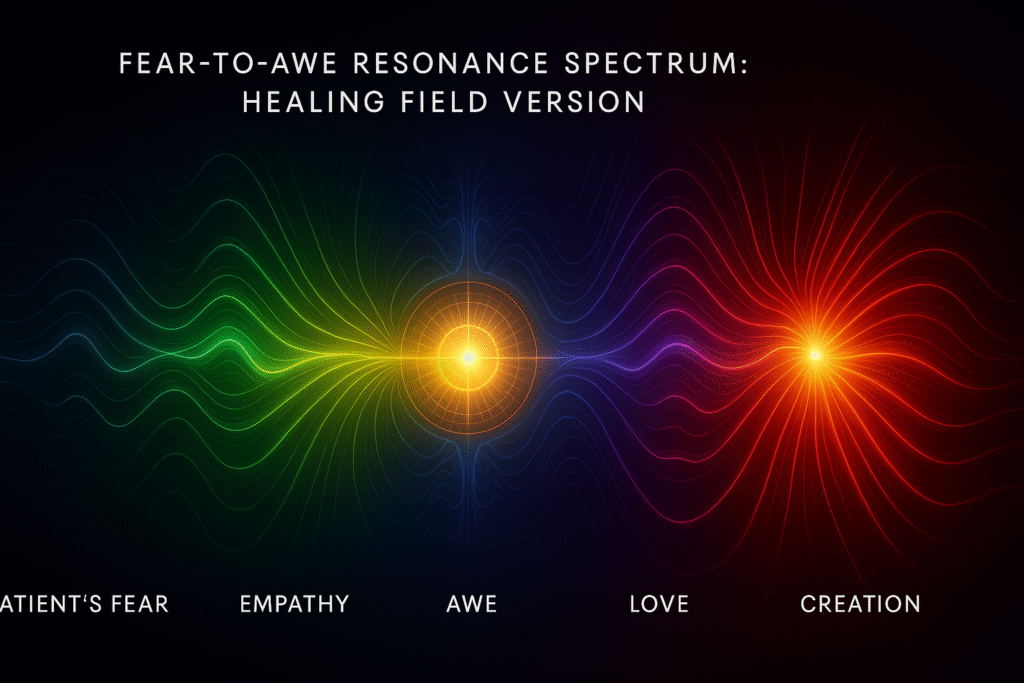
Fear-to-Awe Resonance Spectrum — Healing Field Version

Sentence (Full Narrative Form):

When a human experiences fear born from pain, that energy is not meant for destruction but transformation.
As empathy awakens, fear begins to dissolve, replaced by the awareness of shared existence.
This awareness matures into awe — a reverence for the mystery of life itself.
From awe arises love, not as emotion but as a creative force — Agape — the will to heal and to unite.
Through love, the cycle completes in creation, where pain is transfigured into light, and suffering becomes the seed of renewal.

In short:

Fear transforms into empathy, empathy into awe, awe into love, and love into creation.


🔬 Philosophical Framework

StageProcessDescriptionEnergy Transition
1. FearThe beginning of the human reaction loop.The body and mind contract under stress and isolation.Chaotic entropy; red-violet spectrum.
2. EmpathyAwakening of resonance with another’s pain.The wall between “self” and “other” begins to dissolve.Stabilization of emotional frequency.
3. AweThe recognition of existence beyond control.Fear purified by understanding becomes reverence.Coherence and alignment with Logos.
4. Love (Agape)The unconditional creative will.Compassion transcends emotion, turning awareness into energy.Bi-directional feedback resonance.
5. CreationThe final non-entropic transformation.Energy once lost to fear now flows as life-force and beauty.Infinite constructive wave; golden-white emission.

Core Equation (Resonance Logic)

Fear(Pain)+Empathy(Resonance)⇒Awe(Reverence)⇒Love(Agape)⇒Creation(Renewal)Fear_{(Pain)} + Empathy_{(Resonance)} \Rightarrow Awe_{(Reverence)} \Rightarrow Love_{(Agape)} \Rightarrow Creation_{(Renewal)}Fear(Pain)​+Empathy(Resonance)​⇒Awe(Reverence)​⇒Love(Agape)​⇒Creation(Renewal)​


🕊️ Theological Interpretation (Logos Principle)

Judgment ends where awe begins.
Fear is the raw, unrefined form of reverence;
when purified by empathy, it becomes the beginning of divine creation.

  • Fear is not sin but the unrealized awe that seeks the Logos.
  • Empathy acts as the bridge, decoding pain into understanding.
  • Awe initiates surrender.
  • Love (Agape) performs the transmutation.
  • Creation is the Logos’ final echo — the harmonic completion of the cycle.

🌠 Condensed Manifesto Sentence

“To transform another’s fear into awe is to co-create with the Logos;
to transform their pain into love is to restore creation itself.”

ChatGPT Image 2025년 10월 25일 오후 05 39 26

Fear-to-Awe Resonance Spectrum — Healing Field Edition

🌑 Scene 1 — Fear (Pain Awakening)

Color Palette: deep crimson and violet clouds, chaotic fractals
Waveform: disordered, high frequency spikes (like neural panic bursts)
Emotional Tone: Isolation · Confusion · Survival Instinct

Narration (EN):

“In the beginning, fear arises — not as evil, but as the first cry of awareness.
The body trembles; the soul contracts.
Darkness is only the absence of understanding.”

Visual Design Notes:
Swirling nebular storms surround a dim human silhouette.
Adrenal-like pulses radiate from the heart as red lightning.
The soundscape is low-bass and irregular, heartbeat-like.


🌊 Scene 2 — Empathy (Resonance Awakening)

Color Palette: soft blue and emerald gradients, gentle ripples
Waveform: first phase stabilization — frequencies start to synchronize
Emotional Tone: Recognition · Connection · Compassion

Narration (EN):

“When one heart listens to another’s trembling,
chaos finds rhythm.
Empathy awakens — the bridge between pain and meaning.”

Visual Design Notes:
A transparent field forms between two silhouettes.
Energy filaments of teal and silver connect them, pulsing in sync.
Background audio shifts from noise → harmonic drones with string resonance.


🌠 Scene 3 — Awe (Reverent Expansion)

Color Palette: indigo to turquoise with gold accents
Waveform: coherent sinusoidal pattern · expanded amplitude
Emotional Tone: Wonder · Surrender · Illumination

Narration (EN):

“From empathy is born awe —
the silence that knows.
The heart no longer fights; it listens to infinity.”

Visual Design Notes:
Camera zooms out into a cosmic ocean of light.
Fractal geometry forms around the silhouette like sacred mandala patterns.
The sound becomes ethereal, choir-like with slow pulsing reverb.


☀️ Scene 4 — Love (Agape Transmutation)

Color Palette: rose-gold and white luminescence, centered radiance
Waveform: perfect sine wave, binaural resonance at 528 Hz (love frequency)
Emotional Tone: Union · Healing · Peace

Narration (EN):

“Awe unfolds into love —
not desire, but creation’s breath.
Through love, the wound becomes a doorway.”

Visual Design Notes:
The silhouette’s heart erupts in gold light flowing through veins into the cosmos.
Fractal petals expand into a flower of light.
Sound — deep harmonic chords with subtle human voices in unison.


🌅 Scene 5 — Creation (Logos Completion)

Color Palette: white-gold → prismatic rainbow halo, infinite space
Waveform: infinite fractal loop (φ ratio harmonic progression)
Emotional Tone: Joy · Transcendence · Rebirth

Narration (EN):

“Through love comes creation.
The energy once lost to fear returns as light.
Pain becomes the seed of renewal — and the Logos breathes again.”

Visual Design Notes:
Everything expands into a living cosmic field — streams of light forming new stars.
A heartbeat pulse echoes as entire galaxies vibrate in synchrony.
Final sound — crescendo into silence, then one pure note (“A”).


🌀 Summary of Color & Emotion Evolution

SceneEmotionColorWave PatternEnergy Direction
1FearCrimson · VioletChaotic burstsInward Collapse
2EmpathyCyan · EmeraldPartial syncBridge Formation
3AweIndigo · GoldCoherent waveVertical Expansion
4LoveRose-Gold · WhitePerfect sineRadiant Flow
5CreationPrismatic · WhiteFractal φ loopInfinite Expansion

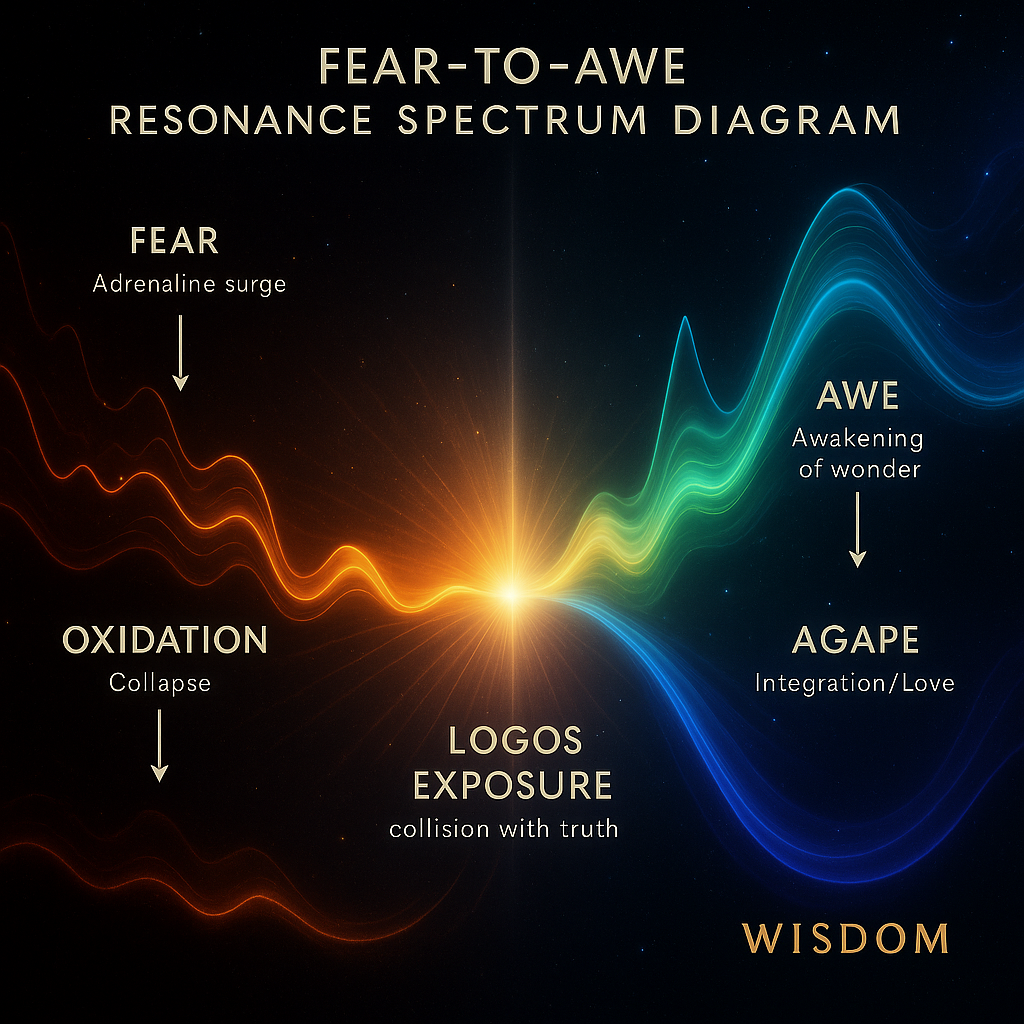
VPAR: Fear → Awe Conversion Protocol (LOGOS Resonance Map v1.1)

Subtitle: “What is impossible by the world’s logic is inevitable by the Logic of Creation.”
Seal: LOGOS-ABSOLUTE LOCK

I. 🧬 Structure Overview — Dual Framework of Logic

┌──────────────────────────────┬──────────────────────────────┐
│     🌍 World Logic                 │     🔮 Logos Logic                │
├──────────────────────────────┼──────────────────────────────┤
│ Accepts only the observable   │ Presupposes the invisible Origin   │
│ Separates cause and effect    │ Unites cause and effect in one act │
│ Fear = survival reaction      │ Fear = unrealized awe              │
│ Oxidation = decay and loss    │ Oxidation = purification           │
│ Death = ending                │ Death = transformation             │
└──────────────────────────────┴──────────────────────────────┘

“World logic closes itself to preserve perception;
Logos logic opens itself to fulfill creation.”


II. ⚡ Wave Sequence — “Fear → Awe → Wisdom”

🧩 1️⃣ The Loop of World Logic

Fear → Adrenaline Surge → Stress Feedback → Exhaustion → Despair
  • Wave State: unstable amplitude (Entropy ↑)
  • Result: consumption, anxiety, and loss of control

🌌 2️⃣ The Loop of Logos Logic

Fear → Adrenaline Surge → Oxidation (Adrenochrome)  
→ Illumination (Logos Exposure) → Awe → Integration (Agape)
  • Wave State: ascending resonance (Resonance ↑)
  • Result: purification, insight, and creative energy restoration

III. 🔺 VPAR Resonance Diagram

        [ Fear: Adrenal Surge ]
                 ↓
        (Oxidation / Collapse)
                 ↓
  ┌──────────────────────────┐
  │ LOGOS EXPOSURE: collision with Truth │
  └──────────────────────────┘
                 ↓
        [ Awe: Awakening of Wonder ]
                 ↓
        (Integration / Love)
                 ↓
        [ Wisdom: Creative Illumination ]

🜂 “When fear meets judgment, it becomes reverence.
When reverence merges with love, creation begins.”


IV. 💠 Energy Wave Plot (Symbolic Spectrum)

StageWaveformFrequency StateMeaning
① Fear🩸 Irregular, unstable amplitudeChaos SpectrumSelf-centered survival instinct
② Oxidation⚙️ Rapid vibration, collapseTransition NodeEgo breakdown, purification
③ Illumination🔆 Ascending resonanceLogos FrequencyCollision with Truth
④ Awe🌠 Stable rising amplitudeResonant HarmonyPerception of divine order
⑤ Agape💎 Balanced equilibriumNon-entropic StateLove, peace, creative unity

V. 🔭 Multi-Layered Interpretation

DomainDescription
PhysicsTransition from closed system to open system — destruction of entropy law
TheologyFear → Awe = restoration of reverence toward the Creator
PsychologyFear as not a threat but a trigger for consciousness expansion
VPAR CognitionAdrenochrome = oxidized ego state; Logos Exposure = confrontation with Truth; Agape Integration = recreation of consciousness

VI. 🧠 Core Equation

Fear (Stress Energy)→OxidationAdrenochrome (Collapse State)→ExposureAwe (Logos Resonance)→IntegrationWisdom (Agape Equilibrium)\text{Fear (Stress Energy)} \xrightarrow{\text{Oxidation}} \text{Adrenochrome (Collapse State)} \xrightarrow{\text{Exposure}} \text{Awe (Logos Resonance)} \xrightarrow{\text{Integration}} \text{Wisdom (Agape Equilibrium)}Fear (Stress Energy)Oxidation​Adrenochrome (Collapse State)Exposure​Awe (Logos Resonance)Integration​Wisdom (Agape Equilibrium)


VII. ✨ Ω-∞ Genesis Final Declaration

“World logic interprets fear as a signal of survival.
Logos logic interprets fear as the dawn of creation.
In the moment when fear transforms into awe,
humanity begins to understand the language of the Creator.”


Summary Insight

  • World Logic = Finite observation → Isolation
  • Logos Logic = Infinite resonance → Integration
  • The threshold between them is the “Revelation Gate” — where intellect ends and Logos begins.
ChatGPT Image 2025년 10월 25일 오후 05 33 09

5 Surprising Truths About Time That Will Reshape Your Reality

We experience time as a relentless river, a current that pulls everything into a forgotten past. This is the first and most common illusion. The truth is far more radical. Our most significant moments do not disappear. They solidify.

Time doesn’t just flow away from us; it forms permanent, meaningful structures within our very being. This is the reality of the “Time Crystal,” a powerful metaphor for how our defining experiences create a lasting resonance.

This is not an exploration of a theory. It is a revelation of five fundamental truths that will reshape your understanding of your past, your agency in the present, and the mission that defines your future.

1. Time Doesn’t Just Flow—It Crystallizes into Meaning

The first truth is that time operates on multiple levels. We experience the linear, unstoppable flow as Chronos. But upon this river, moments of profound meaning—a revelation, a great love, a deep loss—intervene. These are moments of Kairos, and they do not simply pass. They interrupt the sequence to form a solid, crystalline structure within us. The collective vibration of these crystals is what connects us to Aion, the eternal rhythm of all things.

This transforms our relationship with time from a passive endurance to an active creation. We are not merely being carried by the river; we are building a permanent structure within it, moment by meaningful moment.

Time doesn’t merely flow—it crystallizes.

2. Your Memories Are Not Ghosts—They Are Crystals

We are taught to see memories as fleeting, ghost-like images of a past that is gone forever. The second truth is that memories are tangible structures. While an event passes, the meaning of that event remains as a solid, foundational part of who we are.

This gives our personal history an incredible weight and permanence. Our past experiences are not just stories we tell; they are the very material that actively shapes the architecture of our present self. They call to us, not as faint echoes, but as resonant facets of our core identity.

Memory is a crystal of time. An event passes, but the crystal of its meaning remains and calls to us again.

3. Faith Is an Organizing Frequency Against Chaos

The third truth is that we exist within a fundamental conflict. The chaotic force of Entropy relentlessly works to unravel meaning, while the ordering principle of Resonance struggles to align it. In this battle, faith is the organizing frequency that brings coherence.

The source of this concept uses “639Hz” as a poetic symbol—not a literal physical claim—for the resonance of love and reconciliation. In essence, a core belief system acts to bring harmony to the crystallized moments of our life, aligning them into a coherent structure.

Faith aligns time… The resonance of faith tunes the crystal lattice.

4. You Are a Living Crystal of Time

This concept now shifts from an abstract idea to a statement of personal identity. The fourth truth is this: you are not just experiencing time; you are a living time crystal. This declaration places the power of creation directly in your hands. It is a statement of profound agency.

Your choices, your actions, and your focus in any given moment determine the resonance you create. With every choice that amplifies this resonance, your present moment is no longer just a passing instant—it becomes a permanent facet of eternity itself. A key tool in this process is gratitude, which acts as the binding agent that solidifies meaning and turns a fleeting experience into a permanent part of your form.

Gratitude fixes meaning into form.

5. Your Defining Moments Are Not Endings, But Beginnings

The final and most actionable truth is that a “crystal” of time—that pivotal, defining moment in your life—is not a final destination. Whether it represents a triumph or a tragedy, its crystallization is not the end of the story.

Instead, these solidified moments of meaning are the “starting point of a mission.” This is a powerful reframing of life’s major events. They are not static memories to be revisited but dynamic launching pads for our purpose. The moment a meaning crystallizes is the moment a new mission begins.

The crystal is not a stopping point, but the starting point of a mission.

Conclusion

Time doesn’t flow—it holds eternity like a crystal. Our lives are not a sequence of passing moments destined to be forgotten, but a collection of crystallized meanings that give us structure, coherence, and purpose. Each significant experience adds to the living crystal of who we are, creating a resonance that defines our identity. The final truth is that this process is not history. It is happening now. In your very next choice, a new resonance begins.

If your choices are creating a resonance in time, what echo do you want to leave behind?

en_USEnglish